

A codeshare is one flight sold under more than one airline’s name. An interline agreement lets one airline sell you a trip, or carry your bags, across another airline’s flights. Both put you on a plane you did not buy from directly, but they work differently, and the difference decides who rebooks you when something goes wrong, which bag rules apply, and whether your frequent flyer status counts.
This guide explains both in plain terms, shows you how to tell which one you are holding, and covers the traps that cost travelers money.
TL;DR
- Codeshare: one airline flies the plane (the operating carrier) and another sells seats on it under its own flight number (the marketing carrier). You often see “Operated by” on your booking.
- Interline: two or more airlines agree to accept each other’s tickets and handle connecting passengers and bags. Each flight keeps its own airline and flight number.
- When things go wrong: start with the airline that issued your ticket. The operating carrier handles you on its own flight.
- Self-transfer fares are neither. Two separate tickets mean no rebooking and no through-checked bags if you miss the connection.
- Check before paying: operating carrier, baggage rules, and whether it is one ticket or two.
Table of Contents
- What a codeshare is
- What an interline agreement is
- Codeshare vs interline side by side
- Where codeshare and interline differ in practice
- How to tell what you are booking
- The trap that looks like interlining: self-transfer fares
- Which should you choose?
- Our perspective
- Compare your options in one place
- FAQ
- Sources
What a codeshare is
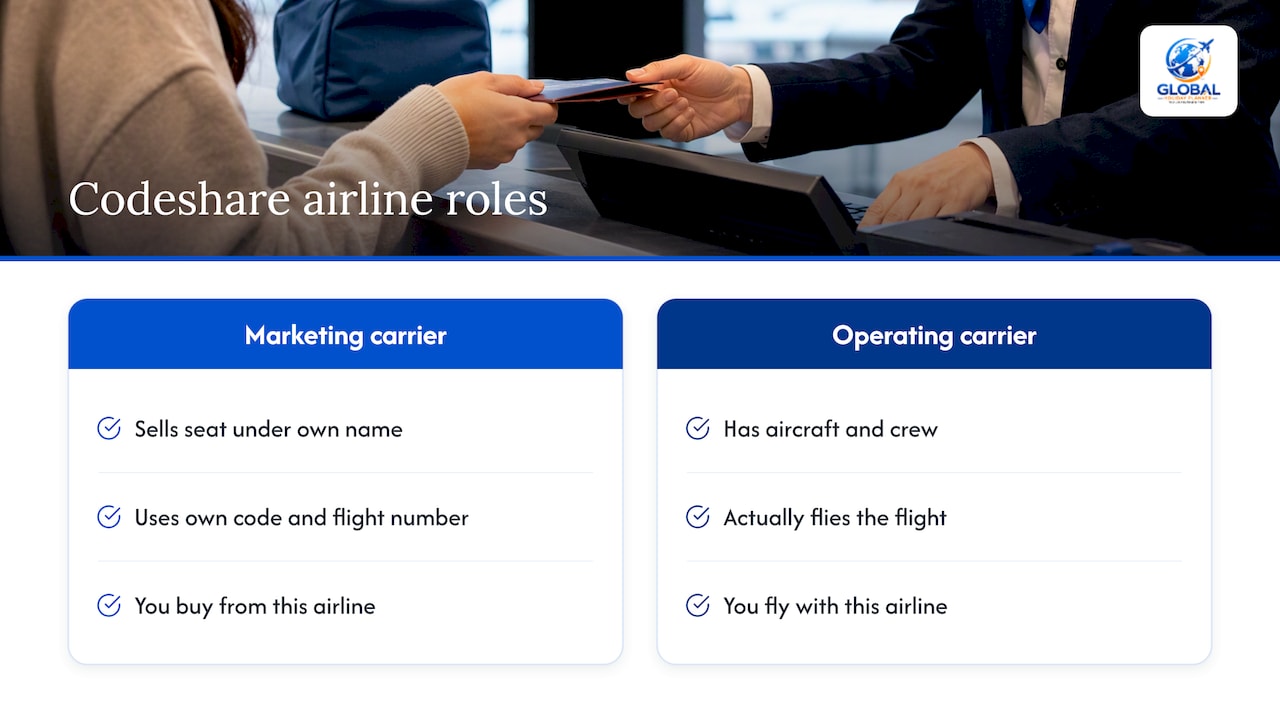
In a codeshare, two or more airlines market the same flight. One airline operates the flight, and the others sell tickets on it under their own designator code and flight number. The airline with the aircraft and crew is the operating carrier. The airline selling you the seat under its own name is the marketing carrier.
A common example: you search a U.S. airline’s website for a trip to a smaller city abroad. The itinerary shows that airline’s two-letter code and a four-digit flight number, yet the plane belongs to a partner. You bought from the first airline. You fly the second.
Why airlines do this is simple. It extends their network to cities where they do not fly, without buying planes or winning slots. For you, it means more routes and often easier booking on a single ticket.
Sellers in the U.S. have to tell you who is really flying. According to a codeshare explainer from Travel Market News, the U.S. Department of Transportation’s codeshare disclosure rule requires “Operated by” wording in schedules, advertising and at purchase. If you do not see it, scroll the flight details until you do.
What an interline agreement is
Interlining is the older and more basic arrangement. It is a commercial agreement between airlines to accept each other’s passengers on connecting flights, with ticketing and baggage transfer across more than one carrier on a single itinerary. Large carriers hold such agreements with well over a hundred other airlines, often under IATA’s Multilateral Interline Traffic Agreement framework, as AeroTime’s passenger guide describes it.
The practical result: you can buy one ticket that combines flights from different airlines, check your bag once at the start, and pick it up at the end. Each leg keeps the flight number of the airline that actually flies it. Nobody puts their code on anyone else’s flight.
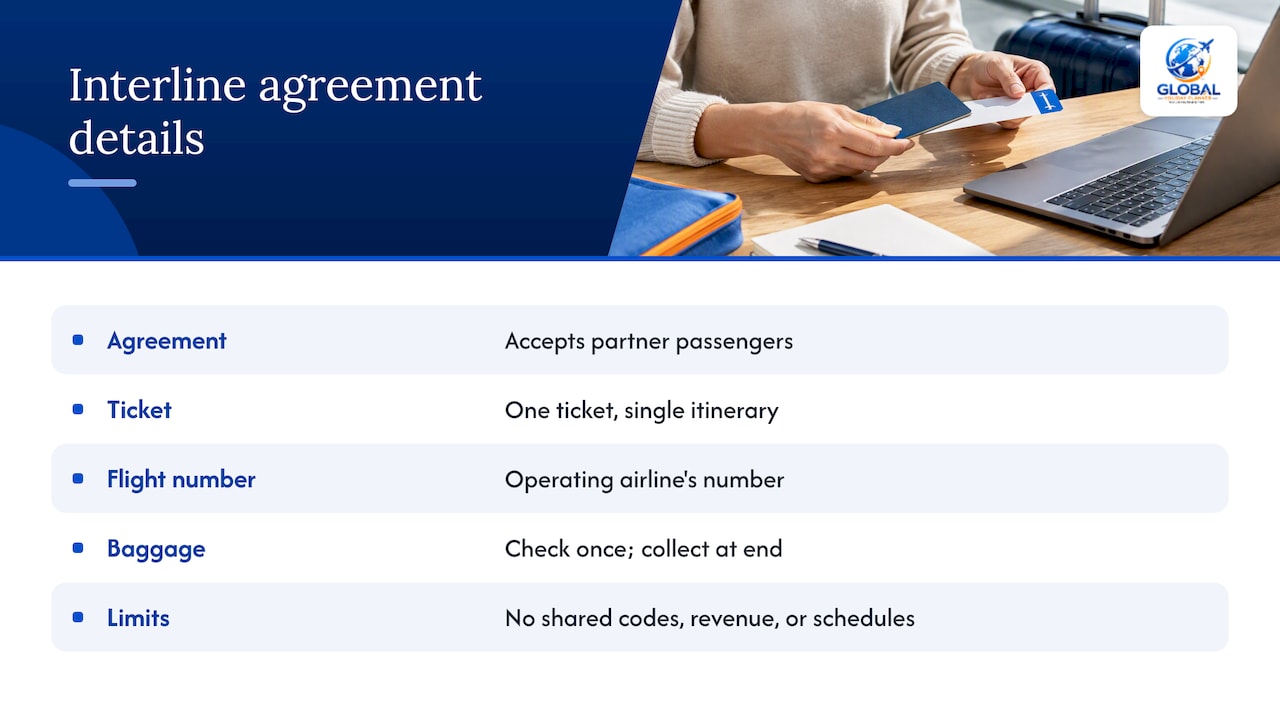
Think of it as a handshake. It says “we will honor each other’s tickets and move your luggage.” It does not say “we will share revenue, coordinate schedules or give you each other’s lounge.”
Codeshare vs interline side by side
| Codeshare | Interline | |
|---|---|---|
| What it is | Same flight sold under multiple airline names | Agreement to honor each other’s tickets and handle bags |
| Flight number | Marketing airline’s code on the partner’s flight | Each airline keeps its own |
| Who flies you | The operating carrier, which may differ from the seller | The airline named on each leg |
| One ticket across airlines | Yes | Yes, when the airlines have an agreement |
| Through-checked bags | Usually | Usually, depending on the agreement and ticket |
| Level of cooperation | Marketing and network integration | Basic passenger and baggage handling |
| Elite status perks | Not guaranteed unless same alliance or bilateral deal | Not guaranteed |
The two often overlap. A partnership can include both an interline agreement and codeshare flights, and airlines in the same alliance usually have both plus status recognition. But you can have either without the other.
Where codeshare and interline differ in practice
Who you call when your flight is disrupted
The airline that issued your ticket is generally your first point of contact for rebooking, per IATA guidance for airlines on interline partnerships. The operating carrier is responsible for you during its own flight, at the gate and on board.
So with a codeshare, keep two names in mind: the airline on your confirmation email and the one operating the plane. Start with the first for changes and refunds. Go to the second for airport-day problems like seats and boarding.
Interline is shakier. IATA notes that interline deals are not alliances, and airlines can pull out of them when a partnership stops paying, for instance when one carrier keeps absorbing the cost of rebooking the other’s passengers. In practice, a protected connection on one ticket is still your best position, but it depends on the airlines involved, so read the itinerary rather than assume.
Baggage
Bags are where confusion costs real money. On an itinerary that includes several carriers, the allowance can follow the most significant carrier on the trip, though rules for itineraries touching the U.S. can require the first marketing carrier’s policy. Allowances are not identical on every leg.
The safe approach:
- Open the booking confirmation and find the baggage line for each segment.
- Confirm whether the bag is checked through to your final airport.
- If your fees differ by carrier, compare the full cost before buying. Our guide to 2026 baggage fees and landed cost for U.S. travelers shows how a bag changes the real fare, and how a $30 bag changes your total walks through the math.
If a bag does not arrive, the carrier handling the final leg and the one that issued your ticket both matter. Our page on U.S. lost luggage compensation lays out the filing windows.
Loyalty status and seats
Partner flights do not automatically give you your usual perks. Per The Points Guy, elite benefits are not guaranteed on the operating carrier unless both airlines share an alliance or have a specific bilateral agreement. Do not assume free bags, lounge access or upgrades travel with you. Look up the operating airline’s rules for your status tier before you count on any of them.
Also expect different seat maps, different onboard service and different change policies. You are flying the operating airline’s product with the selling airline’s ticket.
How to tell what you are booking
You can usually find out in under a minute.
- Look for “Operated by.” Search results and confirmations name the operating carrier. Google’s own flight tools use wording such as “Operated by” and “Tickets also sold by” to separate the two roles.
- Check the flight number. A four-digit number on an airline that usually uses shorter ones is a strong hint of a partner-operated flight. It is a clue, not proof.
- Compare the airline names across segments. Different carriers on one booking reference point to interline or codeshare. Different booking references mean separate tickets.
- Check the terminal. Partner flights often leave from a different terminal than the airline you bought from. Confirm it a day ahead.
- Read the baggage and change rules for both the selling airline and the operating one.
The question “is this flight a codeshare?” also comes up the other way around. If the same flight shows up on several airline sites at different prices, it is probably one aircraft sold by several marketing carriers. Fares and rules can differ even though the seat is the same.
The trap that looks like interlining: self-transfer fares
Some search results combine flights from airlines that have no relationship at all. This is sometimes called virtual interlining. It is not a partnership. Per Google’s travel help, you are buying two separate tickets, so if the first flight runs late and you miss the second, the second airline has no duty to rebook you. You also have to collect and recheck your bags during the layover.
Self-transfers can save money, but only if you:
- leave a generous buffer, often several hours, and never book the final leg on the same day as a tight international arrival;
- confirm you can legally enter the transfer country without a visa when you collect bags;
- check baggage rules on each ticket separately;
- consider travel insurance that covers missed connections, and read the terms, since coverage varies. See our guide on trip cancellation vs interruption for what each covers.
If a trip must work on a fixed day, such as a cruise departure or a wedding, a single ticket with a protected connection is worth the extra fare.
Which should you choose?
You rarely get to choose the legal structure. You choose the itinerary, and the structure comes with it. Use these rules of thumb:
- Pick one ticket over two when the connection is tight, you have checked bags, or the trip has a hard deadline.
- Pick a codeshare on a partner you know when it opens a route you could not get otherwise, and confirm the operating carrier’s baggage and seat rules.
- Pick an interline itinerary when the carriers you want do not partner on flights, but make sure it is still a single booking reference with through-checked bags.
- Pick separate tickets only when the savings are large and you can absorb a missed connection.
If your main goal is a lower total price, compare the whole trip, not just the fare: bags, seat selection, and the cost of a missed connection. Our flexible date flights guide shows how to find the cheapest day, and the group flight playbook helps when you are booking for ten or more travelers on one itinerary.
Our perspective
We built Global Holiday Planner around one idea: the fare on the screen is rarely the whole cost of a trip. Codeshare and interline itineraries are a good example. Two itineraries can look identical, with the same price and the same duration, yet one is sold by a different airline than the one flying, with another bag policy and another phone number to call.
What we tell travelers is simple. Before you pay, find the operating carrier, find the baggage line for each leg, and confirm that the whole trip sits under one booking. That takes a minute and removes most of the surprises we hear about. When we compare options, we look at flights alongside bags, hotels, ground transport and insurance, because a missed connection hits all of them at once.
Our view on self-transfers: they can be a good deal for flexible travelers and a bad one for anyone on a deadline. Match the booking type to how much a delay would cost you.
— Global
Compare your options in one place
When you are ready to book, compare flights on Global Holiday Planner and check each itinerary’s airlines and legs before you choose. Pair the flight with a hotel, an airport transfer or a rental car, so your arrival time and ground plans line up with the real operating flight, not just the marketing code.
FAQ
What does “codeshare flights meaning” boil down to?
A codeshare flight is a single flight sold by more than one airline. One airline operates it, and the others sell seats under their own flight numbers. Your ticket may carry one airline’s name while a partner’s plane and crew take you there.
Is a codeshare flight cheaper than a regular one?
Not necessarily. The same seat can be sold by several airlines at different prices because each sets its own fares and rules. Compare the selling airlines, then check what the operating carrier charges for bags and seats.
Who is responsible if my codeshare flight is delayed or canceled?
Contact the airline that issued your ticket first for rebooking or refunds. The operating carrier handles you at the airport and on board during its flight. Keep both airlines’ contact details handy, since IATA guidance points to the ticketing carrier as the first call.
Will my elite status work on a codeshare or interline flight?
Only sometimes. Benefits usually carry over when both airlines are in the same alliance or have a bilateral agreement. Check the operating airline’s partner rules before assuming free bags or lounge access.
Is an interline ticket safer than two separate tickets?
Generally yes for connections. On one interline ticket, the airlines have agreed to handle connecting passengers and baggage, while on separate tickets the second airline has no obligation if you miss your flight. The protection depends on the airlines’ agreement, so read your itinerary.
Sources
- What are codeshare flights, and how do they work? (The Points Guy)
- Codeshare Flights Explained: Marketing vs Operating Carrier (Travel Market News)
- Interline & codeshare: What passengers need to know (AeroTime)
- Codeshare and interline agreements, United Continental Holdings filing
- Interline and Through Checked Baggage (Qantas)
- IATA guidance document on interline irregular operations
- IATA baseline checklist for new interline partnerships
- Understanding your flight and booking options (Google Travel Help)