

For most trips, rideshare wins on cost and ease for short stays of one to two days in a dense city center, while a rental car wins for three or more days, multi-stop routes, or anywhere outside a major metro. The deciding factors are trip length, how spread out your itinerary is, parking and airport fees, and insurance costs. Many travelers do best by mixing both: rideshare for in-city hops, a rental for the days you need full mobility.
TL;DR:
- Rideshare is typically cheaper for city center trips of one to two days after including all fees, but a rental becomes more cost-effective beyond three days or for dispersed itineraries.
- Accurate cost comparison requires calculating the total all-in price by adding hidden rental fees or surge charges, not just headline rates.
- Safety evidence suggests ridesharing may reduce alcohol-related incidents, but the overall data is low-quality and context-dependent, so it is not always safer.
- Insurance coverage varies; check personal auto policies and credit card benefits beforehand to avoid gaps, especially with liability or damage claims.
- For mixed trips, combining rideshare for urban stays and rentals for longer, multi-stop excursions usually yields the best practical and financial results.
Table of Contents
- 1. How to calculate the real, all-in cost of each option
- 2. Practical convenience trade-offs you’ll feel on the ground
- 3. What the safety evidence says about rideshare and rental driving
- 4. What to check about insurance before you book or ride
- 5. A quick breakeven method to pick the cheaper, more practical option
- 6. How Global Holiday Planner helps you compare all-in costs
- 7. Two traveler examples that show the framework in action
- 8. Ready to compare your own trip’s real costs
- FAQ
- Sources
1. How to calculate the real, all-in cost of each option
The sticker price on a rental listing or a rideshare app almost never matches what you actually pay. Comparing the two fairly means stacking every add-on fee against every per-ride charge, not just the headline rate.
A rental quote usually starts low and grows once you add various fees and charges that are often hidden from upfront price displays. These typically include the base daily rate, airport or concession recovery fees (which can add substantially to airport pickup costs), taxes, insurance or CDW charges if you decline outside coverage, additional-driver or underage-driver fees flagged by the FTC’s consumer guidance on renting a car, fuel policy costs, drop-off fees for one-way rentals, and refundable deposits that tie up funds on your card during the trip.
Rideshare costs look simpler but carry their own layers: a base fare, a per-mile and per-minute charge, surge pricing during busy periods, airport pickup fees, waiting-time charges if your driver sits at the curb, and tips. None of these show up as a single predictable daily number, which is exactly why rideshare can feel cheap for one trip and expensive for ten.
Rental-car airport and concession fees are frequently omitted from upfront price displays, often adding a substantial amount to the final bill. That gap between the advertised rate and the real total is the single biggest reason travelers misjudge which option is cheaper.
Here is the comparison the right way, using generic illustrative numbers. For example, a two-day city stay with multiple rideshare trips, including airport pickup fees, may cost less overall than renting a car once the rental’s airport concession fees, taxes, basic coverage, and parking fees are factored in. Conversely, for a longer multi-day, multi-stop trip outside a downtown core, the fixed daily cost of a rental car—after fees and insurance—can become more cost-effective and practical, usually becoming the better option beyond a few days for such itineraries.
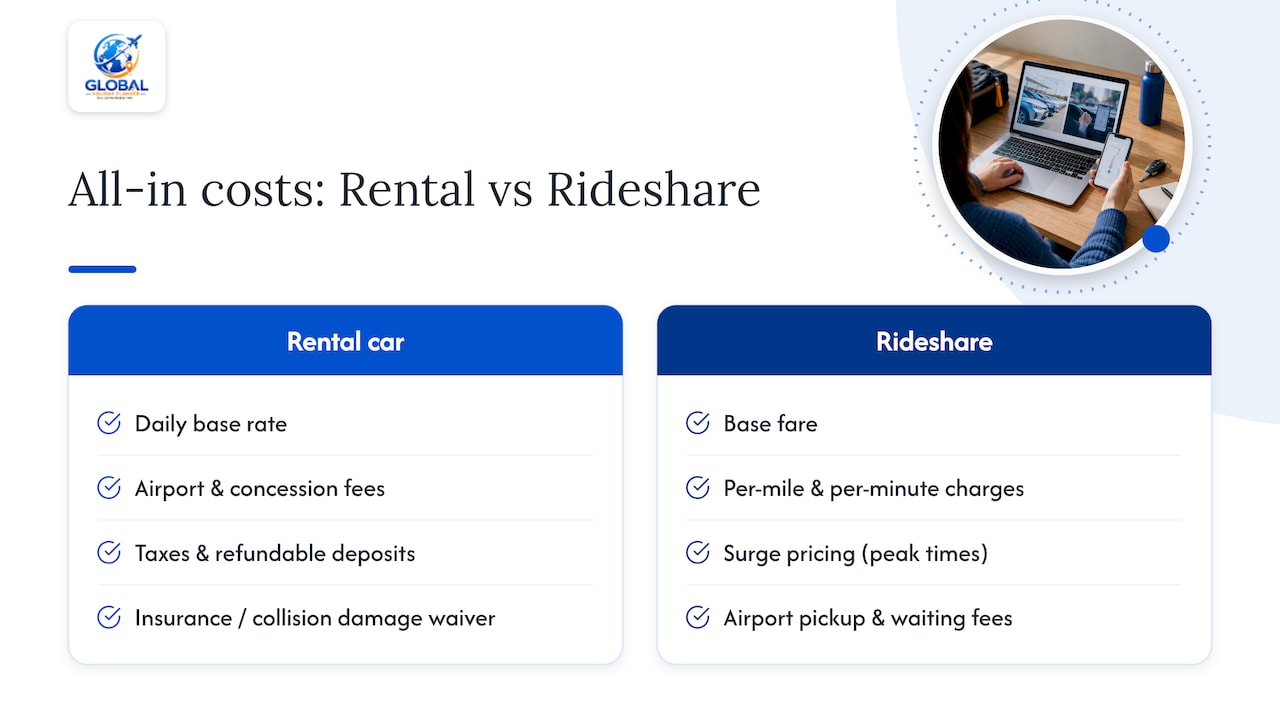
The method matters more than the exact numbers: total every fee on both sides, divide by the number of days, and compare the daily all-in figure, not the quoted rate.
2. Practical convenience trade-offs you’ll feel on the ground
Cost is only half the decision. The friction of each option shapes your actual trip experience, especially when you are tired, carrying luggage, or working with a tight schedule.
Rideshare tends to win when:
- You need a single transfer with no parking to worry about, like airport to hotel.
- Your trip stays within a dense urban core with reliable driver supply.
- You want to skip the rental counter line entirely.
Rideshare tends to struggle when:
- Driver supply is thin outside the city center, leading to long waits.
- Surge pricing spikes during rush hour, bad weather, or big events.
- You have more luggage or people than a standard car can comfortably hold.
A rental car flips those trade-offs. Picking up a car means counter time, paperwork, and sometimes a shuttle ride to a remote lot, which eats into your first day. Once you are driving, though, you are not waiting on anyone, and you can reach places a rideshare driver might refuse or simply never see, like a trailhead an hour outside town or a rural vineyard with no address a mapping app recognizes.
Parking becomes its own calculation. A rental sitting in a hotel garage for two days in a dense downtown can cost nearly as much as the car rental itself, while a rideshare rider never pays for parking at all. That is part of why short, parking-heavy city stays tilt toward rideshare and longer, exploration-heavy trips tilt toward a rental.
Airport logistics differ sharply between the two as well. Rideshare usually means a curbside pickup at a designated zone, sometimes a short walk from baggage claim. Rental pickup often means a counter, an ID and credit check, and possibly a shuttle to an off-terminal lot, adding 20 to 40 minutes before you are even in the car. For a one-night trip, that extra time can outweigh any savings, but for a five-day trip, it is a rounding error.
3. What the safety evidence says about rideshare and rental driving
Safety comparisons between rideshare and self-driven rentals are messier than most cost comparisons, and the evidence has real limits worth understanding before you assume one option is automatically safer.
A systematic review and practice management guideline on ridesharing and motor vehicle crash outcomes found that ridesharing may reduce alcohol-impaired driving incidents, but the overall body of evidence is low-quality and highly dependent on local context. The review’s authors issued only a conditional recommendation, noting that most of the included studies were observational rather than controlled.
A systematic review of ridesharing and crash outcomes concluded that while ridesharing may reduce alcohol-impaired driving incidents, the overall quality of the evidence is low and context-dependent, so rideshare should not be treated as a guaranteed safer substitute for a sober designated driver. This nuance matters for travelers who assume calling a car after drinking is automatically the safer choice in every city and situation; the effect varies by location and study design.
Separately, some research has pointed to rideshare growth coinciding with increases in injury crashes in certain cities, though those findings come from observational, city-specific analyses with their own methodological caveats and should not be read as a universal rule.
For rental drivers, the main risks are different: unfamiliar roads, local driving rules you have not practiced, and fatigue after a long flight before you get behind the wheel. A tired driver navigating a foreign roundabout system for the first time carries its own risk profile that a rideshare passenger never faces.
Practical steps for either mode:
- Pro Tip: Check your rideshare driver’s name, photo, and license plate against the app before getting in, every single time, even on a trip you’ve taken before.
If you are renting, build in a buffer before driving: eat, rest, and review local signage and speed-limit conventions before pulling out of the lot. If you are rideshare-only, avoid relying on it as your sole safety net after drinking in an area where you have not confirmed driver availability and surge pricing in advance.
4. What to check about insurance before you book or ride
The most expensive mistake in this decision is not picking the wrong mode, it is assuming you are covered when you are not. Insurance and liability work differently for rentals and rideshares, and the gaps tend to show up only after something goes wrong.
A Collision Damage Waiver is not the same thing as comprehensive insurance. Per the FTC’s guidance on renting a car, a CDW typically waives the rental company’s right to charge you for damage to the car itself, but it commonly excludes drunk driving, off-road use, and damage caused by an unauthorized driver who was not listed on the agreement. Many rental companies also check driving records at pickup and can refuse to rent to you over recent moving violations or DUIs, and additional-driver or underage-driver fees can change your total cost significantly.
Before you book a rental, work through this short checklist:
- Call your auto insurer and ask whether your personal policy extends to rental cars in the country or state you are visiting.
- Check your credit card’s rental benefits and get the coverage terms in writing, since many cards offer secondary coverage with specific exclusions.
- Ask the rental counter directly whether they run a driving-record check, what their CDW actually excludes, and whether optional products like roadside assistance are worth adding for your trip.
- Confirm who is allowed to drive the car and get any additional driver added on the contract, not informally.
For rideshare, the protections work differently. Passengers are generally covered under the platform’s liability policy while in an active ride, but that coverage has its own limits and does not extend to issues outside the ride itself, like a mishap with your luggage or an incident after you have exited the vehicle. Rideshare passengers should not assume unlimited coverage simply because a ride is booked through an app.
Questions worth asking before you travel:
- Does my personal auto policy or credit card cover rental damage, theft, or liability, and what is excluded?
- Does the rental agreement’s CDW cover off-road driving, unauthorized drivers, or driving under the influence?
- What happens if I return the rental late, with a different fuel level, or to a different location than planned?
A five-minute call to your insurer before you leave can save hours of dispute after you get home.
5. A quick breakeven method to pick the cheaper, more practical option
Once you understand the cost components and the convenience trade-offs, the decision usually comes down to a simple breakeven test you can run in a few minutes.
Start with the basic rules of thumb:
- Short, central-city stays of one to two days generally favor rideshare, since parking and rental fees eat into any savings.
- Trips of three or more days, multi-stop routes, or anywhere outside a major metro generally favor a rental, since the fixed daily cost spreads out and rideshare coverage thins quickly outside city centers.
- Groups of three or more people with luggage often do better with a rental, since splitting multiple rideshare trips across a larger party adds up fast.
- Itineraries with several spread-out stops per day favor a rental, since each separate rideshare trip adds its own base fare and wait time.
To run the breakeven calculation yourself, gather three numbers: your estimated all-in daily rental cost (base rate plus fees, taxes, and insurance, divided by the number of rental days), your estimated number of rides per day, and your average cost per ride including any airport or surge premiums. Multiply rides per day by cost per ride to get your daily rideshare spend, then compare that figure directly to your all-in daily rental cost. Whichever number is lower for your actual itinerary, not the headline price, is your answer for that trip.
Pro Tip: Run the breakeven math separately for your arrival and departure days versus your full exploration days, since the mix of modes that wins often changes day by day.
The hybrid tactic works well for exactly this reason: book a rental only for the days you need full mobility, like a day trip outside the city or a multi-stop itinerary, and rely on rideshare for the days you are staying put in a walkable core. This avoids paying for a parked rental on days you never need it, while still giving you a car when distance or dispersion makes rideshare impractical or expensive.
6. How Global Holiday Planner helps you compare all-in costs
We built our car-rental comparison to solve exactly the problem described above: rental listings that hide airport and concession fees until checkout. When you search car rentals through our platform, we surface the all-in daily price, including the fees that typically get buried, so you can run the breakeven calculation against real numbers instead of a headline rate.
We also make the hybrid strategy easier to plan. If your trip mixes a few in-city days with a multi-stop excursion, you can compare rental options for just the days you need a car and pair them with airport transfers for the days you do not, rather than paying for a parked rental the whole trip.
A few ways to approach this decision:
- Compare rental quotes side by side with fees broken out, not buried in the total.
- Check transfer options for arrival and departure days separately from your main rental window.
- Cross-reference your itinerary’s dispersion against rental pickup locations to avoid paying for a car you will rarely use.
The goal is to see the real total cost before you commit, not after.
7. Two traveler examples that show the framework in action
Example A: A 48-hour stay in a dense downtown core. Four rideshare trips a day at an average cost per ride, including one airport pickup fee on arrival, lands well under what a two-day rental would cost once airport concession fees, taxes, and parking are added. No parking fee, no counter wait, and the itinerary never leaves a zone with strong driver supply. Rideshare wins clearly here.
Example B: A five-day coastal road trip with stops at beaches, a lighthouse, and a small-town market, none connected by reliable rideshare coverage. A rental’s fixed daily cost, even with insurance and fees, spreads out over five days and gives access to stops no rideshare driver would reasonably take. The rental is not just cheaper per day, it is the only practical option for several stops.
The hybrid lesson: if your trip has a city segment and a dispersed segment, split the modes instead of forcing one option to cover both.
8. Ready to compare your own trip’s real costs
Running the breakeven math is only useful if the numbers you plug in are accurate, and that starts with seeing a rental’s full price before fees get added at the counter.

We make that part simple: search car rentals on our platform to compare all-in pricing across providers, or pair a shorter rental with airport transfers for the days you do not need a car. If your trip includes a leg better suited to a private charter than a long drive, Littlebird’s on-demand private flights are worth a look for group travel between regional airports. Check your dates now and see which total comes out lower for your actual itinerary.
FAQ
Is rideshare cheaper than renting a car for a weekend trip?
For a short stay of one to two days in a dense city, rideshare is often cheaper once you factor in rental airport fees, taxes, and parking. The crossover point shifts to favor a rental as your trip stretches past two or three days or spreads across multiple stops.
What are the downsides of rideshares?
Rideshare pricing can spike during busy periods, and driver availability thins out quickly outside major city centers, leading to long waits. Evidence on rideshare and crash outcomes is mixed: a systematic review found that ridesharing may reduce impaired-driving harm but rated the overall evidence as low quality and context-dependent.
What is the difference between car sharing and car rental?
Car sharing typically refers to short-term, often hourly access to a shared vehicle fleet parked around a city, booked and unlocked through an app. A traditional car rental involves picking up a car for a set multi-day period from a counter or lot, usually at a fixed daily rate plus fees and insurance.
Can I use a rental car for rideshare?
Rental car eligibility for rideshare driving depends on the rental company’s own policies and the rideshare platform’s vehicle requirements, which vary by provider and location. Check directly with your rental company and the rideshare platform before assuming a standard rental qualifies.
Should I buy the rental company’s insurance or rely on my own coverage?
A Collision Damage Waiver is not the same as full insurance, and it commonly excludes drunk driving, off-road use, and damage from unauthorized drivers, according to the FTC’s rental car guidance. Call your personal auto insurer and credit card issuer before your trip to confirm what they actually cover, then decide if the rental counter’s add-on products fill any remaining gap.
Sources
- The effect of ridesharing services on motor vehicle crash outcomes: A systematic review and practice management guideline (EAST)
- Federal Trade Commission: Facts for Consumers — Renting a Car
[…] often cheaper for one or two short hops. For short trips, car rental versus rideshare all-in costs shows where the break-even […]
[…] trip components. If you are weighing a rental car against app rides for short stays, our guide on car rental vs rideshare all-in costs uses the same total-cost […]