

For short trips, tight schedules, or celebrations where service matters, book a hotel. For groups, families, or stays longer than four or five nights where a kitchen and separate bedrooms matter more than daily housekeeping, book a vacation rental. The catch is fees: cleaning charges and platform costs can quietly erase a rental’s savings on shorter stays, so run the full math before you commit either way.
TL;DR:
- Hotels generally offer more predictable service, flexibility in cancellation, and are often cheaper for stays under four nights when fees are included.
- Rental costs become more favorable for longer stays or larger groups, especially when cleaning fees are spread over multiple nights.
- A comprehensive cost comparison must include taxes, cleaning fees, platform charges, and expenses like meals and transportation, not just nightly rates.
- Service reliability and responsiveness are key advantages of hotels, particularly for travelers needing quick fixes, accessibility, or safety assurances.
- The best choice varies by trip type and personal needs, with the friction test focusing on ease, costs, and specific amenities relevant to the traveler.
Table of Contents
- Hotel vs. Vacation Rental: Pros and Cons at a Glance
- Which Is Cheaper: Hotel or Rental?
- Hotel or Airbnb: Service and Reliability Differences
- When Should You Choose a Vacation Rental Over a Hotel?
- How to Compare One Hotel and One Rental for Your Trip
- How Global Holiday Planner Simplifies This Comparison
- A Straight Answer From the Global Holiday Planner Team
- Compare Real Total Costs Before You Book
- Sources
- FAQ
Hotel vs. Vacation Rental: Pros and Cons at a Glance
The hotel versus vacation rental debate usually comes down to what you’re willing to trade: predictability for space, or space for predictability. Neither wins outright, but each has clear strengths worth weighing before you book.
Hotels earn their reputation on consistency. You know roughly what you’re getting, whether that’s a Marriott in Denver or a boutique property in Lisbon, and there’s a staffed desk if something goes wrong. Loyalty programs sweeten repeat stays with free nights or upgrades. The tradeoff is space and cost: rooms run small, kitchens are rare, and mandatory extras like resort fees or overnight parking add up fast.
Vacation rentals flip that equation. You get more square footage, a kitchen, laundry, and privacy from other guests, which usually means better value once you’re splitting the cost across three or four people. The downsides show up in the fine print: cleaning fees that don’t scale down for short stays, host response times that vary wildly, and cancellation policies that tend to be stricter than a hotel’s flexible-rate option.
- Hotel pros: predictable service, front-desk support, loyalty perks, daily housekeeping.
- Hotel cons: smaller rooms, added fees, limited or no kitchen access.
- Rental pros: more living space, kitchen and laundry, better per-person value for groups.
- Rental cons: cleaning fees, inconsistent host responsiveness, tighter cancellation windows.
Which Is Cheaper: Hotel or Rental?
Neither option is reliably cheaper across the board. A 2024 market analysis from Skift found that once all fees get tallied, hotels beat vacation rentals in plenty of markets, particularly for short stays. Location and length of stay decide the winner more than the platform does.
The real comparison tool is total trip cost, not the nightly rate you see on the search results page. Add these before you compare anything:
- Cleaning fees and platform service charges
- Security deposits or card holds
- Resort fees, parking, or extra-person charges
- Local occupancy taxes
- Expected meal and transportation costs for each option
Pro Tip: Use this template for both listings: total cost = (nightly rate × nights) + cleaning fee + taxes + parking + expected meals + transport. Whichever number is lower for your actual dates wins, not whichever platform “feels” cheaper.
Rentals typically hit their stride around the four-night mark. A fixed cleaning fee that applies fully to short stays but spreads thinly on longer trips can increase the effective nightly cost of a two-night trip significantly. Travel Hacker’s cost breakdown makes the same point: for stays under four nights, a hotel’s simpler pricing often comes out ahead.
Hotel or Airbnb: Service and Reliability Differences
A hotel’s biggest advantage rarely shows up in the price. It shows up when something goes sideways. Lost key, broken air conditioner, need to store bags after checkout: there’s a person at the desk who can fix it in minutes. That operational backup is why hospitality writers consistently argue that the service and pampering of a hotel stay outweighs the extra square footage of a rental, especially on trips where you don’t want to think about logistics.
That backup matters most for specific travelers:
- Solo travelers who want a staffed lobby and predictable safety standards
- Anyone with a late or early flight who needs flexible check-in
- Guests who need accessible rooms with verified features, not just listed ones
- Celebration trips where the point is being taken care of, not managing a property
Rentals introduce friction hotels don’t have. Self check-in codes fail. Hosts take hours to answer a message about a broken lock. Cleanliness standards swing from immaculate to disappointing depending on how recently the listing was reviewed. Reading reviews from the last three months, not the all-time rating, is the best defense against a bad surprise.
When Should You Choose a Vacation Rental Over a Hotel?
Trip type decides this more than personal preference. A NerdWallet survey found that about half of Americans said they’d choose a rental over a hotel, with the preference notably stronger among younger travelers and parents traveling with kids. Here’s how that breaks down by scenario:
- Short city trip or business travel: hotel. You want a predictable location near your meetings or the sights, not a scavenger hunt for a lockbox.
- Family trip needing separate bedrooms: rental. A kitchen and living room save money on meals and give kids somewhere to be loud without disturbing other guests.
- Large group of six or more: rental. Splitting one three-bedroom property costs far less per person than three separate hotel rooms.
- Anniversary or milestone celebration: hotel. This is where the pampering factor actually earns its price tag.
- Remote destination or cabin-style getaway: rental, simply because hotels often don’t exist where you’re headed.
How to Compare One Hotel and One Rental for Your Trip
Run this five-step check on real listings for your actual dates before booking either one.
- List your must-haves. Number of beds, step-free access, a working kitchen. Anything non-negotiable goes here.
- Calculate full trip cost for both options using the total-cost template from the cost section above.
- Map your daily travel time from each listing to where you’ll actually spend your days.
- Check cancellation and deposit terms side by side. Hotels usually offer more flexible rates; rentals vary property by property.
- Read reviews from the last three months only. Older reviews don’t reflect current management or cleanliness.
Score must-haves as pass or fail, since a missing bed or an inaccessible bathroom is a deal-breaker regardless of price. Score nice-to-haves like a pool or a balcony on a 0 to 3 scale, and let those numbers, not gut feeling, settle a close call.
- Deal-breakers: missing required beds, no step-free access, unverifiable safety features.
- Nice-to-haves: pool, gym access, balcony view, in-unit laundry.
How Global Holiday Planner Simplifies This Comparison
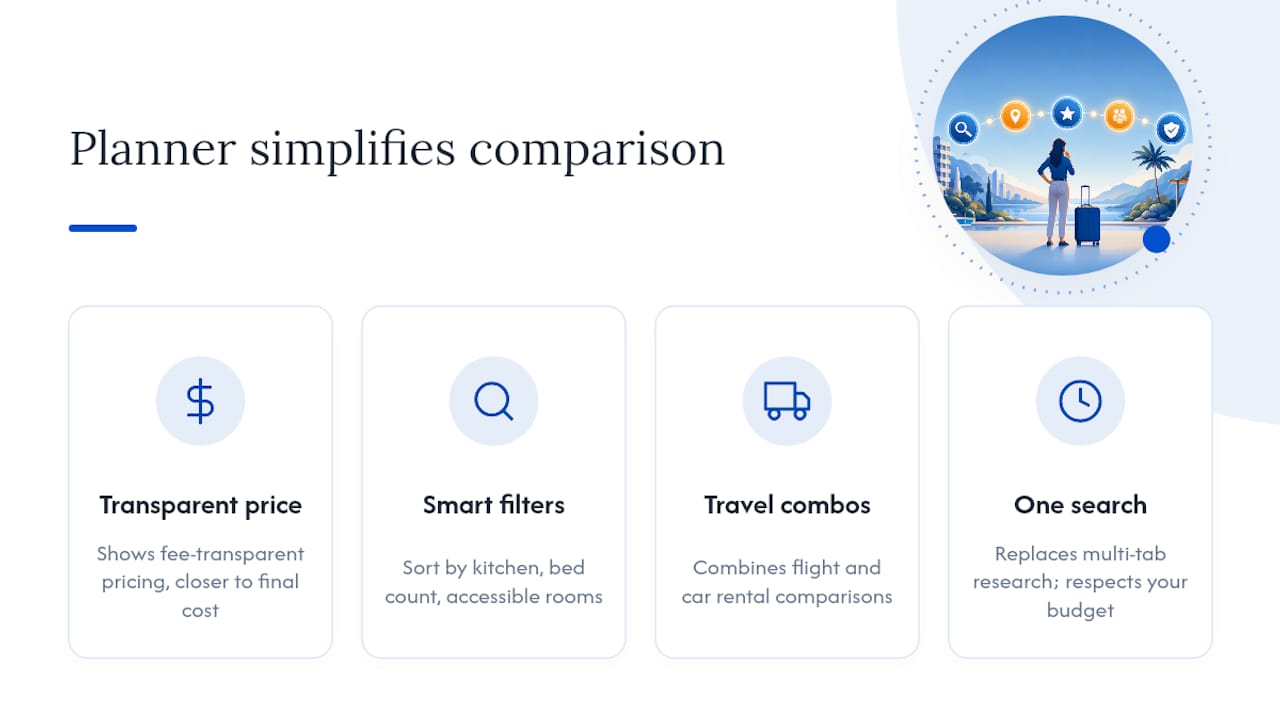
Running the checklist above by hand across five browser tabs is tedious. Global Holiday Planner’s hotel search shows fee-transparent pricing so the number you see is closer to the number you’ll pay, and its filters let you sort by the must-haves you listed in step one, like kitchen access, bed count, or accessible rooms. Combined with flight and car rental comparisons, it turns a multi-tab research project into a single search that respects your actual budget, not just the advertised nightly rate.
A Straight Answer From the Global Holiday Planner Team
The hotel versus rental debate gets treated like a personality test, as if you’re either a “hotel person” or a “rental person.” That framing wastes your time. The right call changes trip by trip: a couple who wants a rental’s kitchen for a week in Tuscany might want a hotel’s concierge desk for a 36 hour trip to New York the following month.
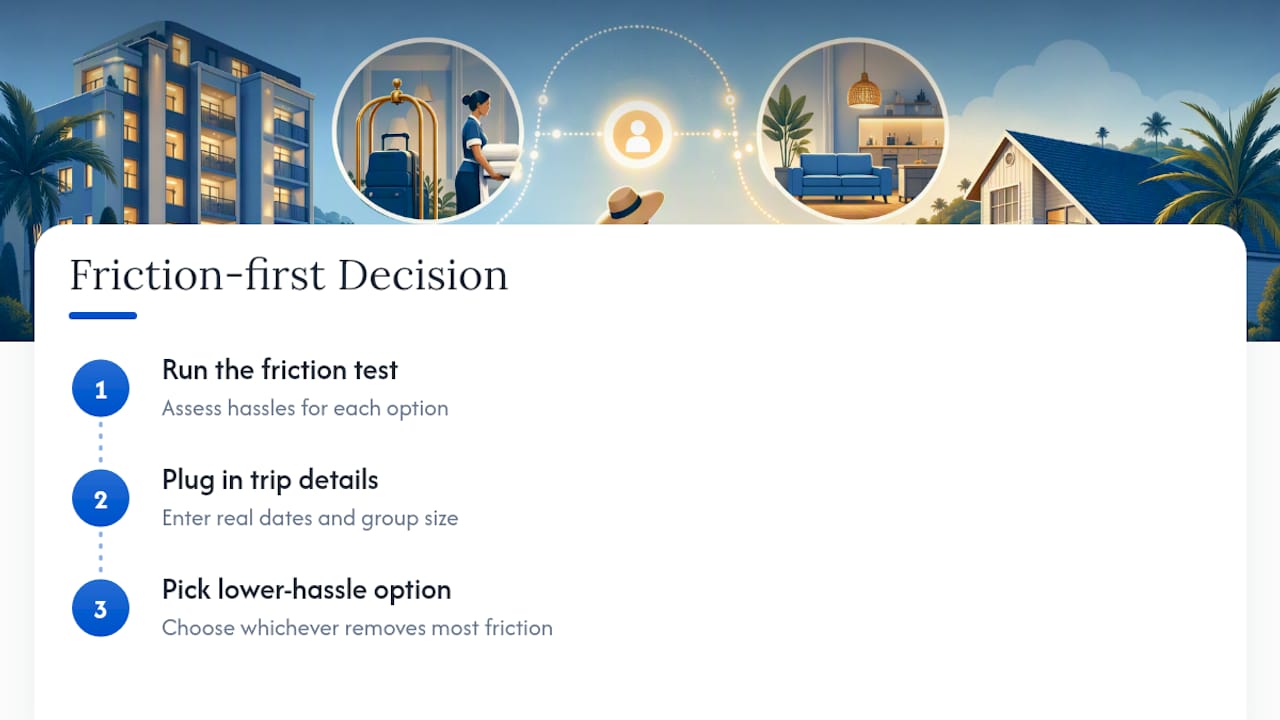
The friction test is the one that holds up. Run the checklist, plug in your real dates and group size, and pick whichever option removes the most hassle from your specific trip. That answer will change constantly, and it should.
— Global
Compare Real Total Costs Before You Book
Guesswork about cleaning fees and resort surcharges is exactly what turns a good rate into a bad surprise at checkout. This platform exists to close that gap: search hotels and see fee-transparent pricing up front, then check flights and car rentals in the same place so your whole trip budget lines up before you commit to anything.

If your dates fall in that shorter, service-heavy category, start with the hotel search and filter for the must-haves from your checklist. Planning a longer multi-stop trip instead? Head to the main search page to compare flights, hotels, and car rentals together, and lock in your dates while the pricing you see is still accurate.
Sources
This guide draws on cost analysis from Skift and NerdWallet. For deeper guidance on rentals, see this guide to choosing holiday homes or this comparison of hotels and rentals.
- Are Airbnbs cheaper than hotels? What the numbers show (Skift)
- Hotel vs. Vacation Rental Preferences: Study Reveals Generational Differences (NerdWallet)
- Hotel vs. Vacation Rental: Which Is Better? (Travel Hacker)
- Hotel stays: Why the service and pampering of a hotel experience beats a rental every time (Brisbane Times)
FAQ
Are Vacation Rentals Better Than Hotels?
Neither is universally better. Rentals tend to win on space and per-person value for groups and longer stays, while hotels win on service, predictability, and short stays under four nights.
Is It Cheaper to Stay in a Hotel or Airbnb for a Month?
For month-long stays, vacation rentals are usually cheaper because the fixed cleaning fee gets spread across many nights and you avoid paying for meals out every day thanks to the kitchen.
Why Do People Pick Airbnb Over Hotels?
Roughly half of Americans say they’d choose a rental over a hotel, according to NerdWallet, largely for the extra space, kitchen access, and better value for families and groups.
Are Hotels Cheaper Than VRBO?
It depends on the market and trip length. Hotels are often cheaper for stays of one to three nights once cleaning and service fees are factored in, while rentals frequently pull ahead on longer stays.