

Carbon offsets can fund real climate projects, but buying one does not make your flight carbon neutral: the emissions still enter the atmosphere. The right first move is to calculate your flight’s actual footprint using an ICAO-based calculator, then decide whether and how to offset. This guide covers the math, the quality checks, where to buy, and the steps to do it right.
TL;DR:
- Most credible flight emissions estimates rely on ICAO’s standardized calculator, which accounts for aircraft type, load factor, and cabin class, unlike simpler distance-only tools.
- Buying offsets does not make flights carbon neutral; they fund projects that aim to reduce emissions elsewhere, but project quality, additionality, and permanence vary.
- High-quality credits come from verified projects with transparent registry entries, demonstrating additionality, permanence, low leakage, and ongoing monitoring, preferably certified by standards like VCS or Gold Standard.
- Consumers should verify project details and serial numbers before purchase, avoid vague claims or suspiciously low prices, and prefer renewable energy or methane capture initiatives over forestry credits.
- To reduce overall emissions, travelers should prioritize smarter routing, direct flights, and economy class before calculating and offsetting remaining footprints through independent marketplaces or airline programs.
Table of Contents
- How flight CO₂ emissions are estimated
- Do offsets for flights actually work?
- How to evaluate high-quality carbon credits and projects
- Where to buy offsets and which tools to use
- Step-by-step: how to calculate and buy an offset for one flight
- How I think about offsetting my own flights
- Planning a lower-emission trip before you offset
- Sources
- FAQ
How flight CO₂ emissions are estimated
Most credible calculators build on the same foundation: the ICAO Carbon Emissions Calculator (ICEC), the internationally recognized standard for estimating passenger CO₂ from air travel. ICEC works by looking up your specific airport pair, mapping the aircraft typically flown on that route, and applying load factors and passenger-to-cargo ratios before running the fuel burn through a standard conversion formula. That last step matters: burning a kilogram of jet fuel produces roughly 3.16 kilograms of CO₂, a fixed multiplier that every serious calculator relies on.
Simpler tools skip most of this. They estimate emissions from distance alone, sometimes applying a flat per-mile figure regardless of aircraft type, cabin class, or how full the plane actually was. That shortcut can produce numbers that look precise but miss real variation between a full economy cabin on a modern widebody and a half-empty regional jet.
A few factors explain why two calculators can give you different answers for the same flight:
- Aircraft type: older or smaller aircraft burn more fuel per passenger mile than newer widebodies.
- Load factor: a fuller plane spreads emissions across more passengers, lowering the per-person figure.
- Cabin class weighting: business and first class seats take up more space and mass, so they carry a higher share of a flight’s total emissions.
- Non-CO₂ effects: some tools apply a radiative forcing multiplier to account for contrails and other high-altitude warming effects, which can meaningfully raise the estimate.
What simple calculators typically omit is any adjustment for these last two points, which is why a quick web estimate and an ICEC-based figure can diverge for the same route. If you want a number worth acting on, prioritize a tool that discloses its methodology over one that just asks for departure and arrival cities.
Do offsets for flights actually work?
Buying an offset funds a project that reduces or removes emissions somewhere else. It does not cancel the CO₂ your specific flight put into the atmosphere. That distinction sounds small, but it is the entire basis for most criticism of offsetting: you are not making your trip carbon neutral, you are making a separate, hopefully equivalent, contribution elsewhere.
The common failure modes are well documented. A project may lack additionality, meaning it would have happened anyway without offset funding, so the credit represents no real change. Forest-based credits face reversal risk: a protected forest can burn or be logged years later, erasing the stored carbon the credit already claimed. Some projects are over-credited, issuing more tonnes of claimed reduction than they actually achieve, and weak monitoring means buyers often have no independent way to check.
Expert reporting on this exact question is blunt about the tradeoff:
Carbon offsets are not a direct atmospheric swap; purchasing credits funds emissions reductions elsewhere and cannot guarantee the flight itself is neutral. The quality, permanence, and verification of projects are the critical difference between meaningful and ineffective offsets.
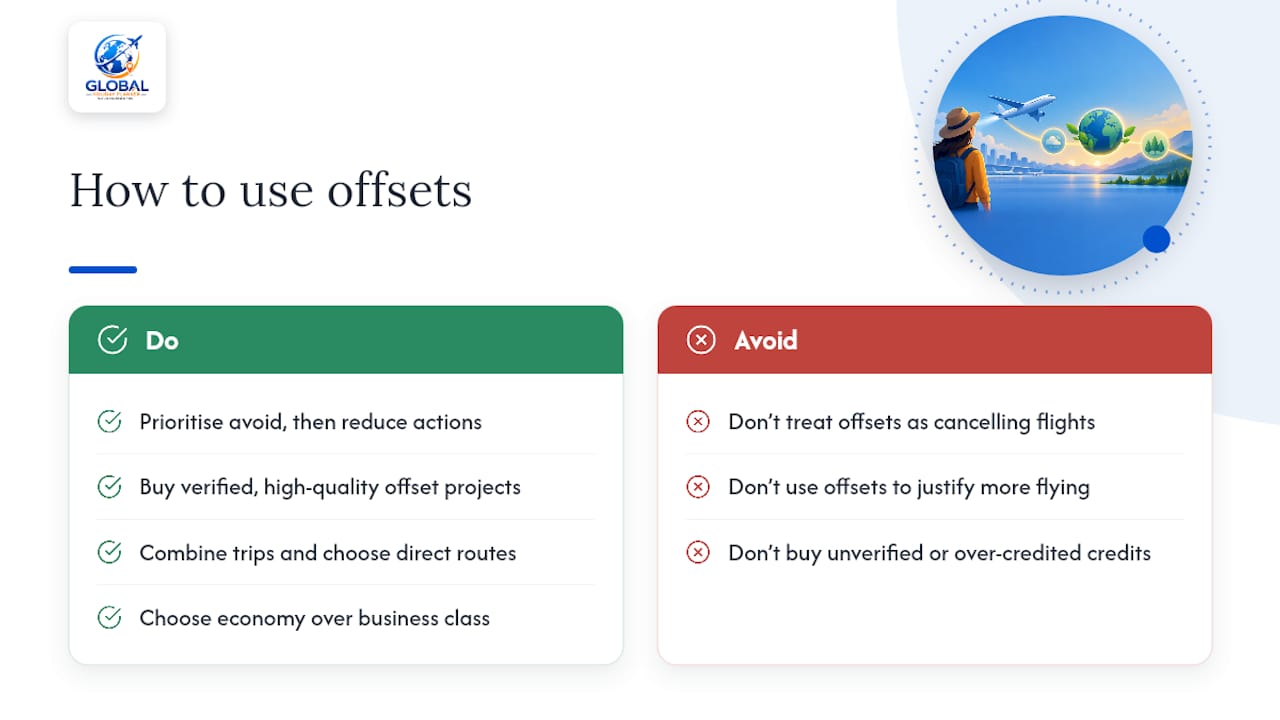
There is also a moral-hazard concern: offsets can make flying feel consequence-free, which risks displacing the more effective habit of flying less in the first place. The accepted hierarchy among climate researchers is avoid, then reduce, then offset, in that order. That does not mean offsets are worthless. It means they are a last step, not a substitute for combining trips, choosing direct routes, or picking economy over business class. Travelers who understand this tend to fund better projects, because they are not looking for permission to ignore the first two steps.
How to evaluate high-quality carbon credits and projects
Not all credits are equal, and the difference usually comes down to four properties. Additionality means the project would not have happened without offset revenue. Permanence means the carbon stays locked away rather than risking release later. Leakage means the project does not simply push the polluting activity somewhere else. Monitoring and verification means an independent party checks the numbers on an ongoing basis, not just at launch.
Oxford’s offsetting principles recommend checking projects against recognized standards and demanding transparency on exactly these points before you buy. In practice, that means looking for:
- A named standard behind the credit, most commonly Verra’s VCS or the Gold Standard, both of which run public project registries.
- A registry listing you can search yourself, showing the project’s location, type, and issuance history.
- A serial number tied to your specific purchase, which should retire on the registry once you buy it.
- Disclosed social or economic co-benefits, since IATA notes many credible aviation-linked projects also support goals like clean water access or local employment, aligned with the UN Sustainable Development Goals.
- A clear breakdown of how much of your payment reaches the project versus administrative costs.
Pro Tip: Search the credit’s serial number on the issuing registry (Verra or Gold Standard) before you buy: if the seller cannot provide one, treat that as a refusal to answer.
Red flags include vague project descriptions, no registry link, bundled “carbon neutral” claims with no breakdown, and prices far below the typical market range for verified credits. Reforestation projects with no long-term monitoring plan deserve particular skepticism given the reversal risk described above. Renewable energy and methane capture projects, by contrast, tend to offer more straightforward permanence because the emissions reduction is locked in at the point of generation.
Where to buy offsets and which tools to use
Once you know your flight’s footprint, you have several routes to actually buy a credit, and they differ mostly in convenience versus transparency.
- Airline at-booking programs: IATA reports that over 50 airlines now offer voluntary offset add-ons during checkout, which is the easiest option but the least consistent: some airlines disclose the underlying project and standard, others bundle it into a vague “carbon neutral” fee. Some carriers, such as Qantas through its Voluntary Carbon Program, match contributions or draw from a documented project portfolio, though pricing and documentation still vary by airline.
- Independent marketplaces and nonprofits: these typically publish full project documentation, registry links, and serial numbers, giving you the transparency airline add-ons often lack.
- Calculator-marketplace combos: tools that let you run an ICEC-based estimate and purchase a matching credit in one flow reduce the risk of under- or over-buying.
- Institutional programs: universities and companies increasingly run their own travel-offset schemes, an approach illustrated by MIT’s travel offset program, which pairs a calculator with an internal purchasing process. Corporate travel programs are also starting to reference CORSIA, the aviation sector’s regulatory offsetting scheme, though CORSIA compliance obligations sit with airlines and states, not individual travelers.
Prices per tonne of verified CO₂ vary by project type and standard, generally landing higher for engineered removal and lower for renewable energy or forestry credits, with cost driven mainly by the project’s verification rigor and co-benefits rather than the seller’s markup.
Step-by-step: how to calculate and buy an offset for one flight
- Gather your flight details: flight number, departure and arrival airports, and cabin class, since all three affect the estimate.
- Run an ICEC-based or similarly transparent calculator and note the resulting CO₂ tonnes, along with whether it applied a radiative forcing multiplier for non-CO₂ effects.
- Pick a project type and standard, choosing between renewable energy, methane capture, or forestry credits certified by VCS or Gold Standard.
- Verify the registry entry before paying, confirming the project is active and the credits you would receive have not already been retired elsewhere.
- Complete the purchase and save your serial number and receipt, and consider reporting the retirement if the seller offers that option, since it creates a public record tied to your specific credit.
Pro Tip: Round your calculator’s tonnage up slightly rather than down: calculators generally estimate on the conservative side, so a small buffer better matches your actual footprint.
The whole process takes about ten minutes once you have your flight details in hand, and it gives you a documented, checkable purchase instead of a vague add-on fee.
How I think about offsetting my own flights
I reduce first: combining trips, flying direct when the fare gap is small, and choosing economy over business when the emissions difference is not worth the upgrade. Only after that do I calculate the remaining footprint and buy a credit from a project with a public registry entry and real co-benefits, usually renewable energy or methane capture over forestry, given the reversal risk. It is not a perfect system. When comparing routes, I use planning tools from an online holiday planner to see which itinerary actually produces less flying before I ever open a calculator.
— Global
Planning a lower-emission trip before you offset
Some travel planning platforms compare flight routings and prices side by side, which makes it easier to spot the itinerary with fewer connections or a more direct path before you even think about buying a credit. Smarter booking will not erase your emissions on its own, but it shrinks the number you eventually need to offset.

A few ways to put that comparison to work:
- Check flight bookings for routes with fewer layovers, since connections add distance and fuel burn.
- Browse tips for finding cheaper, more direct flights to combine trips or avoid backtracking.
- Compare hotel reservations and car rentals alongside your flight to plan a full itinerary in one place.
Smarter booking complements a verified offset, it does not replace one. Once your route is set, calculate the footprint and buy the credit as a separate, deliberate step.
Sources
- ICAO | ICEC
- IATA | Carbon offset
- AP News | People bothered by air travel emissions can buy carbon offsets. Do they work?
FAQ
Which airlines offer carbon offsetting programs?
More than 50 airlines have built voluntary carbon offset options into their booking process, according to IATA. Transparency varies significantly between carriers, so check whether the airline names its project standard and registry before assuming the add-on meets quality criteria like additionality and permanence.
Does Southwest Airlines offer a carbon offset program?
Airline offset programs and their availability change over time and by market, so travelers should check the specific carrier’s current booking flow or sustainability page directly rather than assume a program exists. If no option appears at checkout, an independent marketplace with published registry documentation is a reliable alternative.
How do I offset my flight’s carbon footprint?
Start by running your flight details through an ICEC-based or similarly transparent calculator to get your CO₂ tonnage, then buy a verified credit tied to a registry entry and serial number from a standard like VCS or Gold Standard. Save your receipt and serial number as proof the credit was retired for your purchase.
Can planes fly on 100% sustainable aviation fuel today?
Sustainable aviation fuel (SAF) is currently blended with conventional jet fuel rather than used at full concentration on most commercial flights, and it works alongside offsets rather than replacing the need to calculate and address remaining emissions. Expanding SAF supply and blend ratios is an active area of aviation industry development, but it has not replaced offsetting as the primary tool travelers can access today.
What makes a carbon offset credit high quality?
A high-quality credit is certified by a recognized standard such as Verra’s VCS or the Gold Standard, lists a searchable registry entry, and demonstrates additionality and permanence rather than funding a project that would have happened anyway. Oxford’s offsetting principles recommend checking these factors along with disclosed social co-benefits before purchase.