
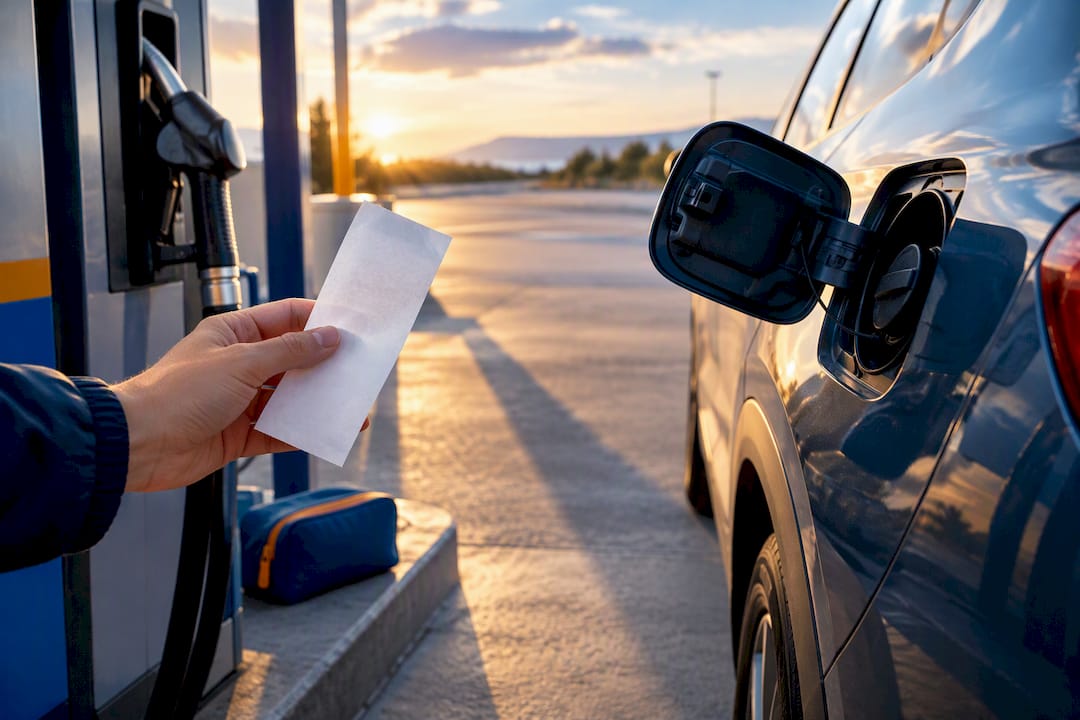
Full-to-full means you pick up the car with a full tank and hand it back full. Do that, and fuel costs nothing beyond what you pump yourself at local prices. Fall short, even by a quarter tank, and the counter will likely charge you a refueling fee well above pump price. The same logic now applies to electric rentals, where “full” generally means returning the battery at the charge level you started with.
TL;DR:
- Returning the car with a full tank is crucial, as refueling late or late receipts can trigger high fees or assumptions of no refuel.
- Photographing the fuel gauge, odometer, and obtaining a near-return receipt are key steps to dispute unnecessary refueling charges.
- Prepaid fuel is rarely cost-effective unless you plan to use the entire tank; full-to-full typically offers the best fairness and value.
- Electric and hybrid rentals follow similar full-to-full principles but require monitoring battery charge levels and charging station availability.
- Booking and comparing rental options with clear fuel policies upfront prevent costly misunderstandings or hidden fees.
Table of Contents
- Understanding the Full-to-Full Fuel Policy in Rental Agreements
- Full-to-Full vs. Prepaid vs. Company Refuel: Which Fuel Option Wins?
- Your Checklist to Avoid Rental Car Fuel Charges
- Electric and Hybrid Rentals Have Their Own “Full” Rules
- Wrongly Charged for Fuel? Here’s How to Dispute It
- Global Holiday Planner’s Take on Choosing a Fuel Policy
- Book a Rental With the Fuel Policy Spelled Out Upfront
- Sources
- FAQ
Understanding the Full-to-Full Fuel Policy in Rental Agreements
Every rental contract spells out its fuel terms, but the wording varies enough that skimming it is a mistake. Hertz’s own policy language is a useful example: it describes the full-to-full option alongside a prepaid Fuel Purchase Option, and it asks renters who choose full-to-full to refill within about 10 miles (15 km) of the return location and hand over a same-day receipt showing the fuel purchase. Miss that distance or that receipt window, and the “we’ll assume you didn’t refuel” clause kicks in.
At pickup, the agent is supposed to note the fuel level on the agreement, often just a checkbox or a gauge sketch, and sometimes their signature. That note is your baseline. Take your own photo of the dashboard fuel gauge and the odometer the moment you get in the car, before you pull out of the lot. It costs ten seconds and it is the single strongest piece of evidence you can produce if a dispute happens later.
Return-side documentation matters just as much. A receipt timestamped hours before drop-off, from a gas station near the airport or lot, is far more convincing than one from a station 40 miles back. Some suppliers are strict about that distance rule; others are more relaxed. Read the specific line in your agreement rather than assuming every company handles it the same way.
Full-to-Full vs. Prepaid vs. Company Refuel: Which Fuel Option Wins?
Rental fuel policies boil down to three real choices, and picking the wrong one is where most people lose money.
- Full-to-full: You return the tank at the same level you received it. Pay only for the fuel you actually use, at whatever the pump charges nearby.
- Prepaid, or full-to-empty: You buy the full tank upfront, drive the car however far you want, and hand it back with no obligation to refill. Convenient, but you eat the cost of any fuel left in the tank when you return it.
- Refuel-by-company: You skip refueling entirely and let the rental company do it. This is almost always the most expensive route, since suppliers charge a per-gallon rate above pump price plus a flat service fee.
Prepaid rarely pays off unless you genuinely expect to burn through the whole tank; unused fuel is nonrefundable, so it mainly buys convenience, not savings, according to Hertz’s own policy documentation. Full-to-full tends to be the fairer deal for anyone who can realistically plan a refuel stop before drop-off, since it charges you for exactly what you use at normal pump prices.
Short rentals carry their own trap. Some US suppliers apply an automatic flat charge, commonly branded something like EZFuel, on rentals under roughly 75 miles unless you return the car full of a same-day receipt in hand. If your trip is short and local, that clause alone can make refueling non-negotiable rather than optional.
Your Checklist to Avoid Rental Car Fuel Charges
Fuel disputes almost always trace back to a missed step, not bad luck. Work through this sequence and you close off every common charge.
- Confirm the policy before you drive off. Ask the counter agent directly whether your contract is full-to-full, and get the fuel type (gas, diesel, EV) confirmed against the car itself, not just the booking screen.
- Photograph the fuel gauge and odometer at pickup. Do this before leaving the lot. Include the dashboard clock or your phone’s timestamp in the shot.
- Plan your refuel stop near the return point, not far from it. Look at the map before the trip starts, not while you’re stressed and running late for a flight.
- Keep every fuel receipt from the trip, but especially the last one. Match the date and time against your return time.
- Top off until the pump actually clicks off. A “close enough” fill is exactly what triggers a fee, since agents check the gauge, not your intentions.
- Get a same-day receipt from a station close to the return location, then ask the returning agent to note the fuel level on the paperwork or their handheld device before you walk away.
- If refueling isn’t realistic, do the math first. Compare the prepaid tank price against what the company would likely charge for a partial refill, then choose whichever number is lower before you commit.
Pro Tip: Set a phone reminder for 20 minutes before your estimated drop-off time labeled “fuel stop.” Airport traffic and rental-return lines eat time fast, and that reminder is often the only thing standing between you and a $9-a-gallon refueling charge.
Electric and Hybrid Rentals Have Their Own “Full” Rules
Electric and plug-in hybrid rentals borrow the full-to-full logic but swap gallons for kilowatt-hours. Return the battery below the charge level you received, and suppliers typically bill you per missing kWh plus a service or administration fee, similar in spirit to a gas refueling charge, according to Enterprise’s own EV rental guidance.

Booking systems flag this ahead of time if you know where to look. ACRISS car codes use a fourth character to mark fuel and power type, with codes distinguishing petrol, diesel, and battery electric vehicles, and the ACRISS electric and hybrid coding now includes battery-charge service notes worth checking before you book.
A few habits keep EV rentals cheap:
- Photograph the dashboard battery percentage at pickup, the same way you would a fuel gauge.
- Route your last leg of driving past a charger near the drop-off location rather than assuming the lot has one.
- If you’re renting near a national park or remote destination, check charger availability in advance. A resource like StayOver’s guide to EV charging near Red River Gorge shows how thin charging infrastructure can be outside major cities.
- Save charging session receipts or app screenshots the same way you’d save a gas receipt.
Wrongly Charged for Fuel? Here’s How to Dispute It
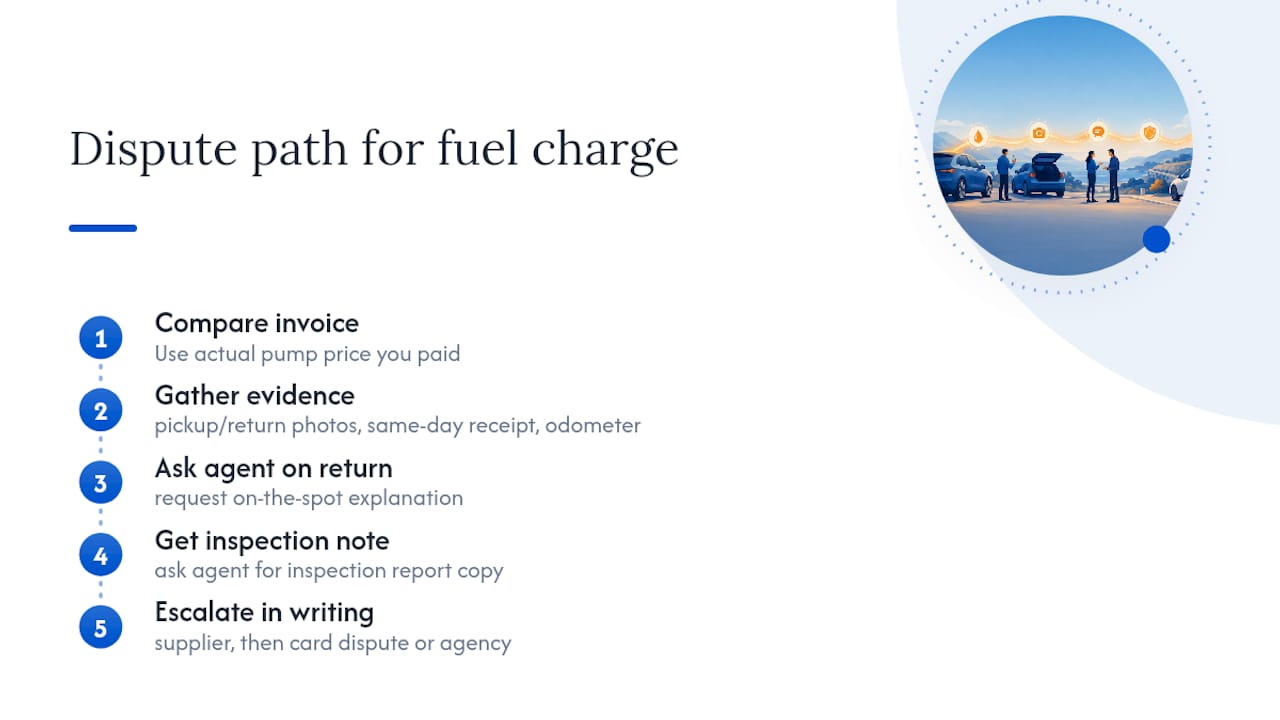
Start by comparing the invoice line item against the local pump price you actually paid, not the average price you remember. Suppliers pad refueling charges with a per-gallon rate above market and a flat service fee, and that markup is exactly what you’re disputing, not the base fuel cost itself.
Line up your evidence: the pickup photo, the return photo, your same-day fuel receipt, and the odometer reading. Courts and administrative boards that have reviewed refueling-charge disputes tend to side with the rental company when the contract clearly disclosed the charge and the renter had a reasonable way to avoid it, but they lean toward the renter when the paperwork is vague or the charge looks punitive relative to actual fuel cost, based on published case law on refueling service charges.
Ask the return agent to explain the charge on the spot, request a copy of the inspection note, and escalate in writing to the supplier if the on-site answer doesn’t add up. If that stalls, a credit card dispute or a complaint to a consumer protection agency is the next step, backed by the same photos and receipts you collected during the trip.
Global Holiday Planner’s Take on Choosing a Fuel Policy
Our default recommendation is full-to-full unless you know, going in, that you won’t have time to refuel or you expect to return the car nearly empty. It rewards planning and punishes procrastination, which is a fair trade for most travelers.
At booking, read the fuel policy line in the listing before you read anything about seat count or trunk space. Build a 20 to 30 minute buffer into your schedule for the refuel stop, especially with an airport transfer on a tight connection. The platform surfaces fuel-policy terms directly in car-rental comparison results, enabling users to weigh the total trip cost, fuel included, before committing to a listing rather than discovering the fine print at the counter.
— Global
Book a Rental With the Fuel Policy Spelled Out Upfront
Guessing at fuel terms after you’ve already booked is how most refueling fees happen. Global Holiday Planner lists the fuel policy right in the car rental comparison results, so you can see full-to-full, prepaid, or company-refuel terms side by side before you commit to anything.

That same comparison view lets you weigh total trip cost, not just the daily rate, since a cheap rental with a bad fuel policy often ends up costing more than a slightly pricier one with fair terms. If your trip involves a tight airport turnaround, pair your rental search with our airport transfer options to build in the extra time a proper refuel stop needs. Check the car-rental page now, filter by fuel policy, and book the option that actually matches how much time you’ll have on return day.
Sources
This guide draws on ACRISS car code guidance, Hertz’s sample fuel policy, and practical explainers from RentalVerdict and CrashTests.
- How ACRISS does it — ACRISS car codes
- Hertz rental fuel policy (example)
- Rental car fuel policy explained — RentalVerdict
FAQ
What Is a “Full-to-Full” Fuel Policy?
Full-to-full means you receive the rental car with a full tank and must return it full to avoid a fuel charge. It’s the default option at most suppliers, and it’s typically the cheapest fuel choice if you can realistically fit a refuel stop into your return route, according to RentalVerdict’s breakdown of rental fuel policies.
How Can I Avoid Rental Car Fuel Mix-Up Charges?
Photograph the fuel gauge at pickup and return, keep a same-day receipt from a station near the drop-off location, and ask the return agent to note the fuel level on the paperwork. Suppliers like Hertz specifically ask renters to refuel within a short distance of the return point and present that receipt to avoid the refueling service charge.
What Fuel Should I Put in a Rental Car?
Check the fuel type printed on the fuel door or the owner’s manual inside the glove box, and confirm it against your rental agreement before you pull away from the lot. The ACRISS code on your booking confirmation also indicates petrol, diesel, or electric power, which is worth double checking if you booked without seeing the actual vehicle.
Is Prepaid Fuel Ever a Better Deal Than Full-to-Full?
Prepaid makes sense only if you’re confident you’ll use close to a full tank and you’d rather not think about refueling before a flight. It rarely saves money otherwise, since unused fuel isn’t refunded once you’ve paid for the tank upfront.
Does Global Holiday Planner Show Fuel Policy Details When I Compare Rentals?
Yes, Global Holiday Planner’s car rental comparison results include the fuel policy for each listing, so you can weigh full-to-full against prepaid or company-refuel options before booking. That makes it easier to judge total trip cost rather than just the daily rental rate.
[…] weigh other add-ons in the same quote: one-way fees, fuel policy charges, mileage limits and child seat rental. The additional driver fee is rarely the largest line on the […]