

For most trips, credit card travel insurance covers the basics: cancellation, delay, lost bags, and rental car damage. It usually falls short on medical evacuation, high-cost cancellations, and anything tied to a pre-existing condition. If your trip involves serious money, older travelers, remote destinations, or a health condition, treat the card as a floor, not a ceiling, and check your issuer’s guide to benefits before you fly.
TL;DR:
- Credit card travel insurance covers basic benefits like trip cancellation, delay, baggage issues, and rental car damage, but often excludes high-cost cancellations and pre-existing conditions.
- Coverage activation depends on booking and paying with the eligible card, meeting minimum spend thresholds, booking round trip tickets, and charging tickets to the same card for family members.
- Major gaps include exclusions for pre-existing conditions, certain destination restrictions, extreme sports, long trip durations, and outpatient reimbursements, especially outside the US.
- Filing claims requires immediate incident reporting, comprehensive documentation, and adherence to submission deadlines, with reimbursements taking weeks or months.
- For expensive or complex trips, supplement your card benefit with standalone insurance policies for higher medical, evacuation, or cancellation limits and compare coverage options before booking.
Table of Contents
- What Credit Card Travel Insurance Actually Covers
- How to Turn On Your Card’s Coverage
- Where Card Coverage Runs Out
- What to Do If Something Actually Goes Wrong
- Deciding: Rely on the Card, or Buy Extra Coverage
- Why We Treat Card Benefits as a Starting Point, Not the Answer
- Compare Coverage and Book in One Place
- Where to Verify Before You Fly
- Sources
- FAQ
What Credit Card Travel Insurance Actually Covers
Credit card travel insurance is a complimentary benefit built into certain cards, activated when you book and pay for your trip with that card. It’s a package of protections, not a single policy, and each piece has its own trigger and its own cap.
The most common categories look like this:
- Trip cancellation and interruption: reimburses prepaid, nonrefundable costs when a covered reason (illness, severe weather, jury duty) forces you to cancel or cut a trip short.
- Trip delay: kicks in after a set delay window, often 6 to 12 hours, and covers meals and lodging while you wait.
- Baggage delay or loss: pays for essentials when a bag is delayed, and reimburses part of a bag’s value if it’s lost for good.
- Emergency medical: a limited benefit that covers acute treatment abroad, usually far below what a real medical emergency costs.
- Emergency evacuation: rare on mid-tier cards, more common on premium travel cards, and one of the most expensive gaps to leave open.
- Rental car damage: covers collision and theft on a rental charged to the card, often as secondary or primary coverage depending on the issuer.
Coverage runs as a benefit built into your flight booking or trip charge, and the numbers vary a lot by card tier. As of 2026, these benefits typically cover events like severe weather, medical emergencies, or job loss, but they require documentation such as receipts and itineraries before the issuer reimburses you.
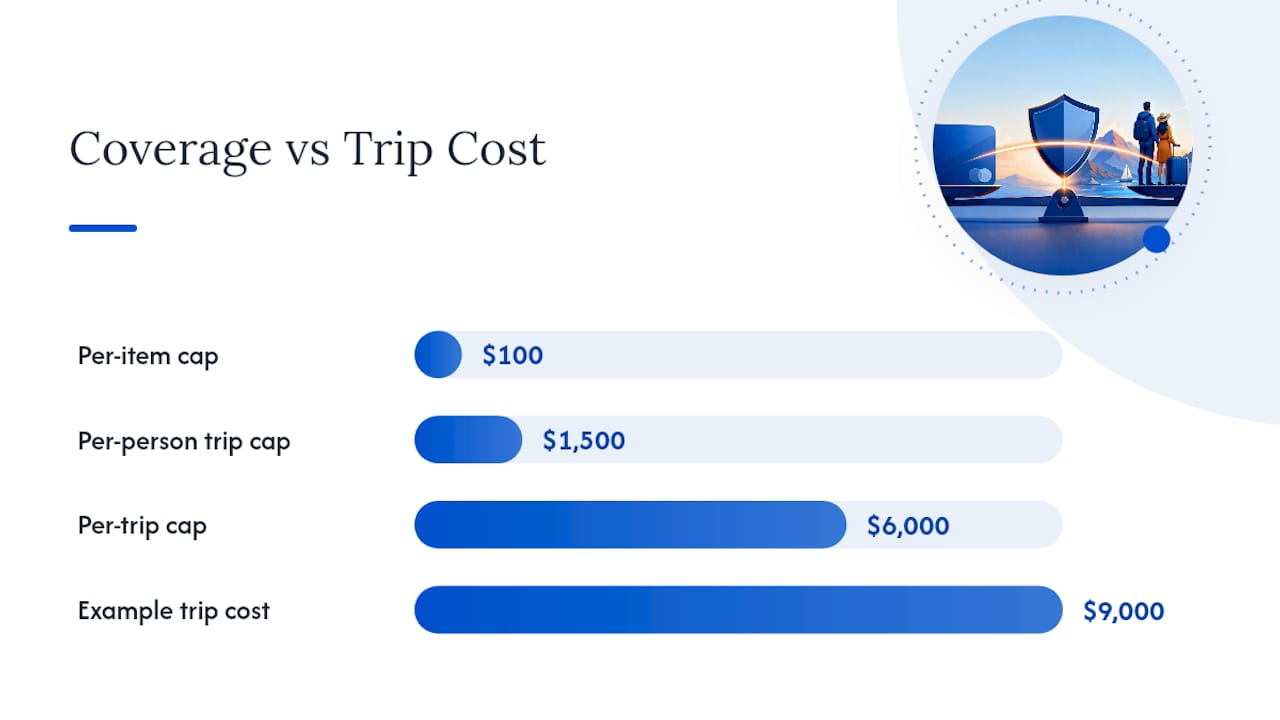
Limits stack in three layers: per-item (say, $100 for a single lost item), per-trip (a cap on total cancellation reimbursement), and sometimes per-year if you file more than once. A card might cap trip cancellation at $1,500 per person and $6,000 per trip. That sounds generous until you’re booking a $9,000 family safari or a multi-leg honeymoon.
One pattern is consistent across the market: the broader benefits cluster on higher-fee travel cards. Independent reviews find that only a minority of consumer cards include travel insurance at all, and the cards that do tend to reserve evacuation coverage and higher medical caps for their premium, annual-fee tiers. A no-fee card might give you baggage delay and nothing else. A $550-fee card might add evacuation up to $100,000.
Statistic to know: Air travel disruption isn’t rare. Federal data on flight operations tracks cancellation and mishandled-baggage rates across the year, and those numbers are exactly why trip delay and baggage benefits get used more than most cardholders expect. Check your own card’s rate of covered events against its payout caps before assuming you’re covered.
How to Turn On Your Card’s Coverage
Card insurance doesn’t activate automatically just because you own the card. It activates when you meet the issuer’s specific conditions, and missing one of them is the single most common reason people think they’re covered and aren’t.
- Pay with the card. The trip, or at minimum the deposit, has to be charged directly to the eligible card, not a debit card, check, or a different card in your wallet.
- Watch minimum spend and per-ticket thresholds. Some issuers exclude low-cost fares below a set dollar amount, commonly around $500 per ticket, so a budget flight booked to save money can quietly fall outside coverage.
- Book round trip, not two one-ways. Two separate one-way tickets often fail to trigger trip protections, even when both are charged to the same card, because the benefit is built around a defined round trip.
- Check reward bookings separately. Paying with points instead of the card’s own funds can void activation unless the issuer explicitly states that award bookings qualify.
- Confirm family and dependent rules. Coverage for a spouse or kids traveling with you often requires that their tickets are also charged to the same card, or that they’re listed as authorized users.
None of this is standardized across issuers, which is the real problem. The only reliable check is pulling up your own card’s guide to benefits and reading the activation clause line by line, not assuming it works like a card you had five years ago.
Where Card Coverage Runs Out
The gaps in credit card travel insurance follow a predictable pattern, and knowing them ahead of time saves you from finding out the hard way mid trip.
- Pre-existing conditions. Most cards exclude claims tied to a medical condition you had before booking, unless you meet a specific look-back window and disclosure requirement, and few cards offer anything like a waiver for this.
- Excluded destinations. Countries under travel advisories or sanctions are often carved out entirely, so a trip to a higher-risk region may have zero coverage regardless of what you paid.
- Extreme sport and activity exclusions. Skiing off marked trails, diving beyond recreational limits, or motorcycle touring can void medical and evacuation benefits even if the base trip is covered.
- Duration limits. Coverage often caps out at 15, 30, or 60 consecutive days, which matters for extended sabbaticals or long international assignments.
- Reimbursement-only cash flow. You pay the hospital, the hotel, or the airline first, out of pocket, then file for reimbursement. There’s no direct pay to the provider.
Government consumer guidance is blunt about this: card insurance often carries higher fixed excesses, commonly around $250, along with tighter trip-duration limits and regional exclusions that vary by issuer. And because domestic health insurance frequently stops working the moment you cross a border, the CDC recommends checking whether your regular plan pays for care abroad before you assume your card’s medical benefit fills that hole.
Pro Tip: Call your health insurer before you book, not after you’re hurt. If your plan (Medicare included) doesn’t cover care overseas, that’s the single clearest sign your card’s medical limit isn’t the safety net you think it is.
What to Do If Something Actually Goes Wrong
Filing a claim on card travel insurance is a paperwork exercise, and the sequence you follow in the first 48 hours determines whether it goes smoothly.
- Report the incident immediately. Get a delay code from the airline, a police report for theft, or a doctor’s note for illness, on the day it happens, not a week later.
- Collect every receipt as you spend. Meals during a delay, emergency clothing, a hotel booked last minute, all of it needs a dated, itemized receipt.
- Call the benefits administrator, not just the card issuer. Most travel benefits are run by a third-party claims company; your card’s customer service line will redirect you.
- Submit the claim packet within the stated window, typically 30 to 60 days, with receipts, the original itinerary, and any carrier notices attached.
- Follow up in writing if you haven’t heard back within the administrator’s stated timeline, and keep copies of everything you send.
This is a reimbursement model from start to finish: you front the money, then get paid back, and that gap can run weeks or months. Keep a buffer on the card or in savings so a denied hotel bill doesn’t become a cash crisis while you wait.
Denials cluster around a few repeat causes: late notification, missing primary documentation like an airline’s official delay code, and undisclosed pre-existing conditions. The fix is almost always the same, report fast, document everything in the moment, and don’t rely on memory to reconstruct a timeline three weeks later.

Deciding: Rely on the Card, or Buy Extra Coverage
Run through this before you book anything expensive or complicated:
- Estimate your worst-case loss. Add up nonrefundable deposits, flights, and any medical exposure if something goes seriously wrong abroad, then compare that total to your card’s stated caps.
- Check the pre-existing condition and destination rules in your card’s guide to benefits against your actual health situation and itinerary.
- Weigh trip cost against trip length and activity risk. A three-night domestic trip is a different bet than a six-week trip with a scuba certification course.
- If the numbers don’t match, buy a standalone policy that fills the specific gap, not a generic bundle. That might mean medical and evacuation coverage only, or a “cancel for any reason” add-on for a nonrefundable wedding package.
Timing matters more than most travelers realize. Buying a standalone policy right after your first trip payment, rather than weeks later, is what unlocks time-sensitive protections like cancel-for-any-reason waivers and keeps a later-diagnosed condition from being ruled pre-existing.
Pro Tip: Treat your card’s insurance as the base layer and shop standalone coverage for exactly what’s missing, medical, evacuation, or CFAR, instead of buying a full duplicate policy you don’t need. It’s cheaper and it closes the real gap.
Why We Treat Card Benefits as a Starting Point, Not the Answer
Card travel insurance is genuinely useful, and genuinely incomplete, and pretending otherwise does travelers a disservice. We build trip planning around comparing what your card already gives you against what a standalone policy adds, rather than assuming either one is automatically enough. Booking with a qualifying card and running a transparent policy comparison side by side catches the gaps before they cost you money. Always verify the fine print in your card’s own guide to benefits, since issuer terms change.
— Global
Compare Coverage and Book in One Place
Global Holiday Planner is the practical alternative to piecing together coverage from memory or a card’s fine print alone. Instead of guessing whether your card’s caps match your trip cost, you can compare standalone travel insurance plans side by side, see coverage limits laid out plainly, and book flights, hotels, or rental cars in one flow.

That side-by-side view matters most when your card’s benefit guide is vague on numbers. Seeing caps for medical, evacuation, and cancellation next to each other, rather than buried in a PDF, makes it obvious where a standalone policy actually adds value versus where you’d just be paying twice. It also keeps your documentation cleaner: booking through one platform means your receipts and itineraries live in a single place, which speeds up any claim you eventually file. If you’re planning a trip where the stakes are real, a family vacation, a long-haul honeymoon, a business trip with tight connections, start by comparing flights and insurance together and book once you know exactly what’s covered.
Where to Verify Before You Fly
Your card’s own guide to benefits is the only document that states your exact coverage, activation rules, and exclusions, and it overrides anything a blog (including this one) tells you in general terms. For health coverage abroad, the CDC’s travel insurance guidance explains why domestic health plans often stop working overseas. The State Department’s insurance checklist lists exactly what to verify, including medical transport and current condition coverage, before you rely on any policy, card-based or standalone.
Sources
- More than money: credit card travel insurance | Capital One
- Credit card travel insurance | Smartraveller (Choice)
- InsureMyTrip data shows cruise travelers are buying insurance earlier — why it matters
- Health care abroad: travel insurance | CDC
- Air travel consumer report — DOT
FAQ
Do I get free travel insurance with my credit card?
Some cards include complimentary travel insurance automatically when you charge your trip to that card, no extra premium required, but the benefit only activates if you meet the issuer’s specific payment and eligibility rules.
Which credit card gives the best travel insurance?
There’s no single best option across the board. Coverage breadth generally scales with the card’s annual fee, with evacuation coverage and higher medical caps showing up mostly on premium travel cards, so the right answer depends on your own card’s guide to benefits.
Do any credit cards give free travel insurance?
Yes, but it’s a minority of cards, and the benefit is usually built into premium or travel-focused cards rather than basic no-fee cards.
What credit cards have travel insurance coverage?
Coverage varies by issuer and card tier, and the only reliable way to confirm what your specific card includes is to check its published guide to benefits rather than assume based on card brand or network.
Is credit card travel insurance enough on its own?
For low-cost, short domestic trips, often yes. For expensive, long, or medically risky trips, card coverage usually leaves gaps in medical, evacuation, and cancellation limits that make a standalone policy worth the added cost.