

Yes, travel insurance is worth it when your trip carries real financial exposure: nonrefundable cruises or packages, international travel without medical coverage abroad, remote or adventure destinations, or group commitments like a destination wedding. Skip it for a cheap, fully refundable weekend trip close to home.
TL;DR:
- Travel insurance is essential for expensive, nonrefundable bookings, especially if cancellation costs exceed a few thousand dollars or your financial comfort zone.
- It provides crucial coverage for medical emergencies and evacuations in remote or adventure destinations where costs can reach six figures.
- The cost for coverage usually ranges from 3% to 8% of the trip’s total, with higher premiums for older travelers and those adding cancel for any reason options.
- Purchase insurance within 14 to 21 days of booking to secure pre-existing condition waivers and benefits like cancel for any reason.
- Always review existing coverage from credit cards, health plans, or airline policies to avoid unnecessary overlaps and gaps in protection.
Table of Contents
- When Is Travel Insurance Worth It? Key Scenarios
- What Travel Insurance Actually Covers (and Where It Doesn’t)
- How Much Does Travel Insurance Cost?
- Your Step-by-Step Decision Checklist
- When Should You Buy Travel Insurance?
- Do You Already Have Coverage? Checking Overlaps
- Why Trust This Guide
- Our Take: Insure the Loss That Would Actually Hurt
- Compare Travel Insurance Plans Before You Book
- Sources
- FAQ
When Is Travel Insurance Worth It? Key Scenarios
The math changes depending on what you’re booking and where you’re going. Here’s where the numbers actually favor buying a policy.
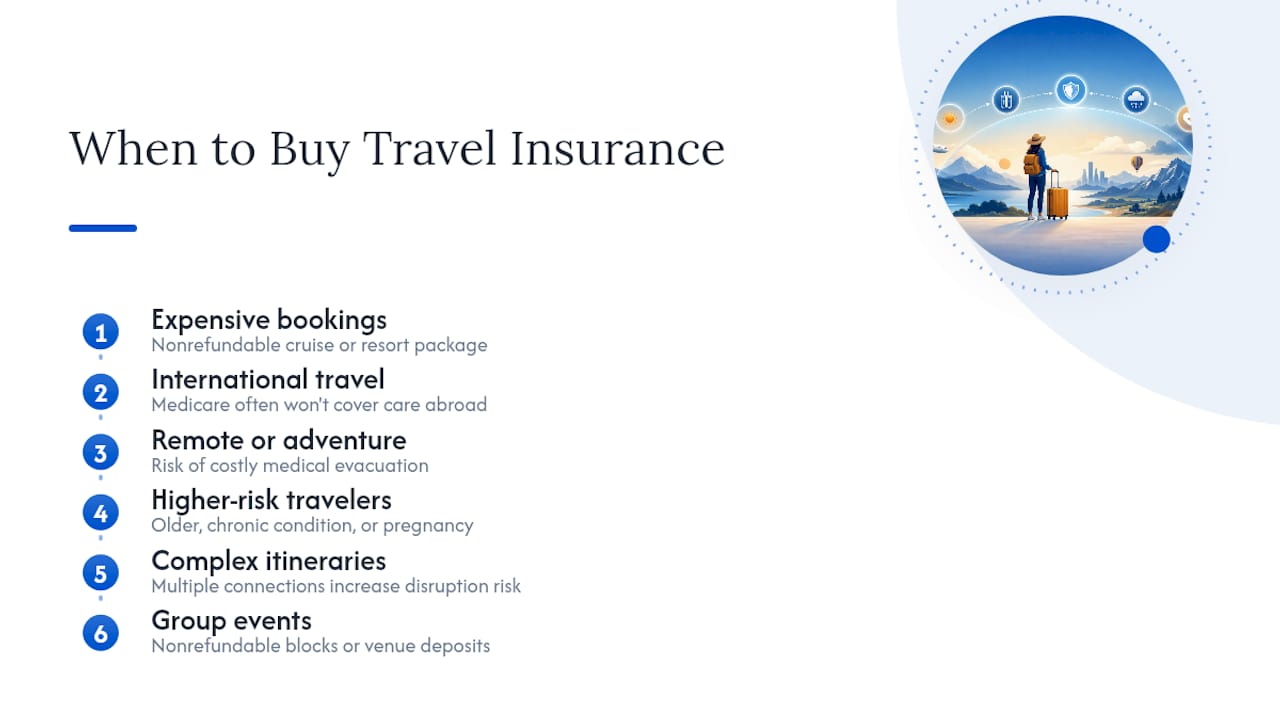
Expensive, nonrefundable bookings. A cruise, an all-inclusive resort package, or a multi-city guided tour usually locks in your money weeks or months before departure. If a family emergency or sudden illness forces you to cancel a $6,000 cruise two days before boarding; you’re out the full amount without coverage. Consumer finance outlets commonly point to a certain amount per person as the informal line where losing that money would genuinely hurt, and that’s a useful gut check for your own trip.
International travel without adequate health coverage. Original Medicare generally doesn’t pay for care outside the United States, so travelers relying on it need a standalone medical policy for any trip abroad. Even travelers with solid domestic insurance often find their plan stops at the border.
Remote destinations or adventure travel. Trekking in Patagonia or diving off a small island chain sounds thrilling until you need a medical evacuation. Costs for evacuation and repatriation can run from the tens of thousands of dollars into six figures depending on location, according to industry cost data. That’s not a bill most households can absorb out of pocket.
Higher-risk traveler profiles. Older travelers, anyone with a chronic condition, and pregnant travelers face steeper odds of a covered cancellation or medical event, and premiums usually reflect that.
Complex itineraries and peak-season travel. Multiple connections and layovers stack up disruption risk. Airline delay and cancellation trends tracked on the DOT’s airline customer service dashboard show why a missed connection during a tight itinerary can cascade into real losses.
Group events and destination weddings. When you’ve got a nonrefundable block of hotel rooms, a venue deposit, and a dozen guests who booked flights around your date, one cancellation can ripple through everyone’s finances.
What Travel Insurance Actually Covers (and Where It Doesn’t)
A policy is really a bundle of separate coverages, and knowing which ones matter for your trip is the difference between paying for the right protection and paying for padding.
- Trip cancellation and interruption reimburses prepaid costs when you cancel or cut a trip short for a covered reason: illness, a death in the family, a natural disaster at your destination. It typically requires documentation like a doctor’s note or a police report, and it excludes cancellations for reasons you already knew about when you bought the policy.
- Travel medical and medical evacuation fills the gap left by domestic health insurance. Most travel medical coverage is secondary, meaning it pays after your regular insurer processes the claim, so check whether a policy offers primary coverage if you want faster reimbursement.
- Baggage loss and travel delay benefits cover lost luggage and reasonable expenses during delays, usually with modest per-item and daily caps. The Department of Transportation’s baggage guidance outlines what airlines owe you directly, which is worth checking before assuming insurance is your only recourse.
- Cancel for any reason (CFAR) lets you walk away from a trip for reasons outside a standard policy’s list, but it must be purchased within a short window after booking and typically reimburses only 50% to 75% of your costs, per NAIC guidance.
Common exclusions across most policies include pre-existing conditions (unless waived), known events like a named storm that’s already forming, and injuries from excluded high-risk activities such as backcountry skiing.
Pro Tip: Read the “covered reasons” list before you buy, not after you file a claim. If your biggest worry is a work conflict or a change of heart, only CFAR covers that. Everything else requires a specific, documented reason.
How Much Does Travel Insurance Cost?
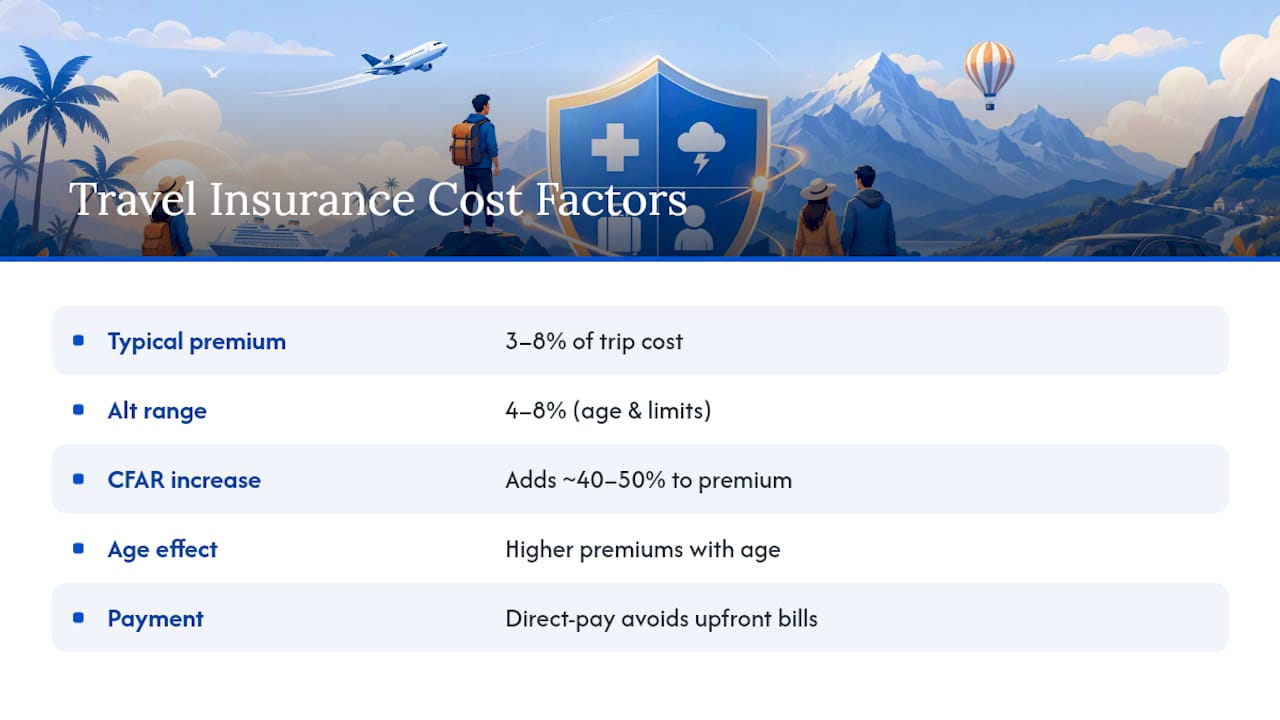
Most travelers can expect to pay roughly 3% to 8% of their total trip cost for standard coverage, though some sources widen that range to 4% to 8% depending on age and coverage limits, based on NAIC’s cost guidance.
For example, insurance on a few-thousand-dollar trip might cost in the low hundreds of dollars; prices scale with trip cost and coverage level.
Age moves the needle more than most people expect: a traveler in their 60s or 70s often pays noticeably more than one in their 30s for identical coverage limits, because medical claims risk rises with age. Adding CFAR increases the premium by roughly 40% to 50% on top of the base policy, according to NAIC’s breakdown.
One distinction that trips people up: some medical policies reimburse you after you pay a provider, while others pay the hospital or evacuation company directly. Direct-pay arrangements matter enormously in a real emergency abroad, since few travelers can front a $50,000 evacuation bill and wait for reimbursement.
Your Step-by-Step Decision Checklist
Run through this before you decide, and you’ll end up with a clear answer rather than a guess.
- Add up your nonrefundable exposure. List every prepaid, non-refundable cost: flights, hotel deposits, tour packages, event tickets. That total is your real financial risk if the trip falls apart.
- Set your “maximum acceptable loss.” Decide honestly what dollar amount you could lose without real financial pain. If your nonrefundable total exceeds that number, insurance starts looking necessary rather than optional.
- Audit what you already have. Check your health plan’s overseas coverage, your credit card’s travel benefits, and any homeowners or renters policy that might cover stolen luggage. Note the gaps, not just what’s covered.
- Assess your destination’s actual risk. Look up medical costs and safety conditions for where you’re headed using State Department travel advisories, and factor in how remote the location is if you’d need evacuation.
- Pick add-ons deliberately. Add CFAR only if flexibility matters more than cost, and add a pre-existing condition waiver if you or a travel companion has a relevant health history. Buy within the eligibility window, which is often 14 to 21 days after your first trip deposit.
- Build a claims folder now, not later. Save every booking confirmation, receipt, and relevant medical record in one place from the day you book.
Pro Tip: Take a screenshot or PDF of your policy declarations page the day you buy it. Insurers can update online policy details, and having your own timestamped copy avoids disputes about what you actually purchased.
When Should You Buy Travel Insurance?
Timing controls which benefits you’re even eligible for. Pre-existing condition waivers usually require purchase within 14 to 21 days of your first trip deposit, and miss that window and the waiver disappears for good, according to NAIC.
CFAR carries its own strict timing: buy it alongside your initial policy purchase, not later, and you typically must cancel at least 48 hours before departure to claim the benefit. Named-event exclusions matter too. Once a hurricane has a name or a strike has been announced, any related cancellation is already a known risk and won’t qualify for coverage bought afterward. The practical move: buy insurance the same week you make your first nonrefundable payment, not the week before departure.
Do You Already Have Coverage? Checking Overlaps
Before paying for a new policy, check what you’re already carrying. Many premium credit cards include baggage and delay protection, but only about 32% of consumer cards offer meaningful travel insurance perks, and most require you to book the trip on that specific card to activate the benefit.
- Credit card coverage tends to cap out lower than standalone policies and often excludes trip cancellation for personal reasons.
- Airline and booking-site add-on insurance is convenient at checkout but frequently comes with narrower terms than a standalone plan.
- Self-insuring makes sense for low-cost, fully refundable trips: book flexible fares, choose refundable hotel rates, and skip the premium entirely.
- If you’re traveling with pets, check your pet travel safety checklist too, since standard travel policies rarely cover animal-related costs.
Comparing your card’s fine print against a standalone quote for the same trip usually reveals the gap fast, especially around medical and evacuation limits.
Why Trust This Guide
Global Holiday Planner’s comparison tool for travel insurance plans is built to let you filter by medical limits, evacuation caps, and CFAR availability rather than guess at checkout. This guide draws on guidance from the NAIC, the U.S. Department of Transportation, and travel.state.gov. Always confirm current terms with your insurer, since rules and thresholds shift by policy and jurisdiction.
Our Take: Insure the Loss That Would Actually Hurt
The honest framework isn’t “insurance is good” or “insurance is a waste.” It’s math. Insure the specific dollar amount you can’t afford to lose, whether that’s a $4,000 nonrefundable package or a six-figure evacuation bill, and skip coverage for trips where the downside is trivial. Buy early enough to keep your waiver and CFAR options alive, save every document the moment you book, and call the insurer directly when a policy clause reads ambiguous. A five-minute phone call beats a denied claim months later.
— Global
Compare Travel Insurance Plans Before You Book
Here’s the honest shortcut: you don’t need to read forty pages of policy fine print to make a good decision. Global Holiday Planner’s travel insurance comparison page lets you filter plans side by side by medical coverage limits, evacuation caps, CFAR availability, and price, so you can apply the checklist from this guide in minutes instead of hours.

Start by entering your trip cost and destination, then filter for the coverage type that matches your biggest risk, medical evacuation for remote trips, cancellation coverage for expensive nonrefundable bookings, or CFAR if your plans might change. If you’re still finalizing your itinerary, pair it with flight booking through the same platform so your travel dates and insurance purchase window line up correctly. Once you’ve settled on a policy that matches your actual exposure, you can lock it in and move on to the rest of your planning with one less unknown hanging over the trip.
Sources
- Should you get travel insurance? | NAIC
- Lost, delayed or damaged baggage | U.S. Department of Transportation
- Travel Advisories | U.S. Department of State
- Travel Insurance 101: When it’s worth buying | Condé Nast Traveler
FAQ
Do I really need travel insurance?
You need it when your trip involves nonrefundable costs you can’t absorb, international medical exposure, or remote/high-risk travel. For a cheap, fully refundable trip, you likely don’t.
Is it worth adding cancel for any reason coverage?
CFAR is worth it if flexibility matters more than cost, since it adds roughly 40% to 50% to your premium but only reimburses 50% to 75% of your trip cost, and it must be purchased soon after your first deposit.
How much is travel insurance for a $10,000 trip?
Expect roughly $300 to $800 for standard coverage on a $10,000 trip, based on the common 3% to 8% pricing range, with costs rising further if you add CFAR.
At what point should you purchase travel insurance?
Buy within 14 to 21 days of your first nonrefundable trip deposit to preserve pre-existing condition waivers and CFAR eligibility, rather than waiting until closer to departure.
What’s the biggest risk of skipping travel insurance?
The biggest risk is losing your entire nonrefundable trip cost to a cancellation, or facing a medical evacuation bill that can reach six figures with no coverage at all.